Showing posts with label National Transitional Council (NTC). Show all posts

Tuesday, 21 August 2012

Libya arrests 32 Qadhafi loyalists over twin car bombings


The Libyan authorities have arrested 32 members of a network loyal to former leader Mu'ammar Qadhafi in connection with Sunday's twin car bombings in Tripoli. According to a number of reports, two people were killed by bomb blasts near a former military academy for women and the interior ministry.
A security agency said the group had been linked to the bombings, the first of their kind since the overthrow of Qadhafi last year. The bomb attacks took place on the eve of the anniversary of the fall of Tripoli to rebel fighters last year. The attacks occurred at dawn, one of them close to the interior ministry's administrative offices, and the other near the military academy on Omar al-Mokhtar Avenue.
Tripoli's head of security Col Mahmoud Sherif said the blast outside the military academy left two people dead and four or five injured. No casualties were reported from the other explosion. Sherif said that Qadhafi supporters were responsible for the attacks. He also alleged they were receiving financial backing from contacts in neighbouring countries.
Another official speaking to Reuters news agency said that a connection between the group and the attacks had been established. The attacks took place as crowds prepared for mass morning prayers to mark Eid al-Fitr, the Muslim celebration at the end of the fasting month Ramadan.
Earlier this month, Libya's National Transitional Council (NTC) handed over power to a newly elected assembly, in the first peaceful transition in the country's modern history. But outbreaks of violence remain a frequent occurrence, which the security forces are strugging to curtail.
Sources: BBC News, Reuters, Bloomberg
For more news and expert analysis about Libya, please see Libya Focus and Libya Politics & Security.

Thursday, 2 August 2012

Libya: Security system failures


There has been a failure of the security system in protecting those elements of, or close to, the government of the National Transitional Council (NTC), particularly in Benghazi. Among the victims of this particular instability is a military intelligence official, Suleiman Buzraidah, formerly in Qadhafi's employ, who was killed in a drive-by shooting incident on 28 July. This is seen in Libya as part of a well-integrated plot to eliminate from the ruling group those suspected of involvement in the deaths of individuals during the Qadhafi era. In all, it is suggested by government sources that as many as 106 names of officials in office during the Qadhafi period appear on the death list of the covert vigilante organisation. The shooting of Buzraidah was followed by the death in a bombing incident of Hameed Ali Kunduz. In June, Colonel Saleh al-Warfali, another Qadhafi regime official suffered a similar fate and this was again associated with the anti-Qadhafi extremists within the current regime.

On 29 July, again in Benghazi, General Khalifa Hafter was fortunate enough not to be included in the above reckoning. The gunmen who fired at the convoy in which he was travelling failed in their assassination attempt, leaving him unhurt.

The peace has also been disturbed by a continuation of the feuds raging in the Misrata region, particularly including confrontations between militia men from Bani Walid and locals from Misrata. At the same time, the violence affecting the Zwai and Tebu tribes in the Al Kufrah area continues and now includes a sub-theme of arms sales and smuggling.

On 30 July, a delegation of seven members of the Iranian Red Crescent arrived in Benghazi to discuss with their Libyan counterparts co-operation in humanitarian aid. At 01:00 on 31 July on the way to their hotel they were kidnapped by gunmen. There is no further information.

For more news and expert analysis about Libya, please see Libya Focus and Libya Politics & Security.

© 2012 Menas Associates

Thursday, 21 June 2012

Libya: Latest clashes leave 105 dead


According to Libyan authorities, recent tribal clashes in western Libya have left 105 people dead and around 500 seriously wounded. Government spokesman Nasser al-Manaa said there had been no fighting in the area since Monday 18 June, following the deployment of the army.

The towns in the crossfire include Zintan, Mizdah and Shegayga, approximately 150km south of Tripoli. The most recent clashes are seen as a test for Libya's new government, which has struggled to assert its power.

The recent battles were mainly between fighters from Zintan, backed by another tribe known as the Guntrara from Mizdah, and armed members of the Mashashya tribe based in Shegayga.

According to experts, the conflict dates back to the Colonel Mu'ammar Qadhafi era when one tribe was given land expropriated from another. It is thought that the latest spurt of fighting was sparked by the death of a man from Zintan after he was stopped at a checkpoint, which Zintan militias have blamed on the Mashashya tribe.

Libya's ruling National Transitional Council (NTC), which took power last year, has been trying to maintain stability since the civil war ended. The latest fighting comes just weeks ahead of elections for a national assembly.

Sources: Reuters, BBC News, WSJ

For more news and expert analysis about Libya, please see Libya Focus and Libya Politics & Security.
Tuesday, 12 June 2012

Situation in Benghazi has not yet stabilised


The post-election situation in Benghazi has not yet stabilised and minor demonstrations are still taking place. It looks, however, as if the Muslim Brotherhood did best and reportedly took about a third of the available seats. So far, the majority of the candidates have, however, shown no sign of amalgamating, and going forward it appears that individuals will act independently.

The head of Tripoli Military Council, Abdul Hakim Belhadj, recently declared that he would stand as a candidate in the National General Congress elections. He has therefore separated himself from his past connections with the Libyan Islamic Fighting Group and has been careful to take a very moderate line in the run-up to the elections. On the basis of the Benghazi local elections, it is forecast that the Islamists will fare only moderately well in the coming ballot.

There is on on-going debate on the likelihood that the elections, scheduled for 19 June, will be postponed. It was reported on 3 June that they would be delayed as a result of an National Transitional Council (NTC) decision to extend the time period during which candidates could register and conduct their public campaigns. The local press cited the resulting lack of time to produce accurate ballot papers.

In any event, it is common wisdom in Libya that even if it is delayed by a week or two, the poll will have to take place and most sources indicate that the election organisation is generally on time. The chairman of the Libyan Higher National Elections Commission, Ali Askar, has indicated that the elections would go ahead as planned. The overwhelming reason to avoid a delay is the escalating impatience of the young and the revolutionary groups to bring about a change in government.

For more news and expert analysis about Libya, please see Libya Focus and Libya Politics & Security.

© 2012 Menas Associates

Wednesday, 16 May 2012

Libya: Most imams are opposed to Islamic extremism

Given the problems the Libyan regime is experiencing in arranging the current political balance – more or less one of tension followed by negative actions – it is imperative that the establishment of the election proceeds without any major disruption. Any hiatus arising from the activities of the militias or major political shifts by players in the elections will be viewed by the majority of the Libyan people as another government failure.

Of great assistance to the regime is the fairly consistent advice from the imams that honest Libyans should baulk at the disruptive activities of extremists. This message has been put out in direct and simple language through the mosques although, as yet, there is no guidance available as to the relative importance of these main religious leaders.

In an interview, Minister of Religious Endowments Dr Hamza Abu Faris stressed the importance of opposing the hostile movements controlled by the Islamic fundamentalists. Faris, like many Libyans who were educated at serious Islamic schools, takes a much more philosophical view concerning the entry into the country of non-Islamic workers, and is content to endorse the response of the average Libyan against the Islamists, as do most of the imams who are working in the country.

The religious establishment, rather like the National Transitional Council (NTC), is anxious for the country to avoid civil war and the Islamist terrorist attacks that occur elsewhere in places such as Iraq, Afghanistan and now Syria. It is very aware that, throughout the long battle for the control of Libya, religion has not played a damaging or divisive role and that there are real causes for discomfort which must be faced if the country adopts a radical Islamist programme. The imams would like to see Libya escape without a fully-fledged civil war.

For more news and expert analysis about Libya, please see Libya Focus and Libya Politics & Security.
© 2012 Menas Associates

Thursday, 3 May 2012

Libya: NTC finds running of the state an expensive operation


The National Transitional Council (NTC) is finding that the running of the state is an acrimonious and expensive operation. For example, as not in previous issues of Libya Politics & Security, the costs of providing overseas health care to both those wounded fighters and the wider Libyan population has caused major recriminations. In recent weeks a bitter atmosphere has arisen from the decision of the NTC chairman, Mustafa Abel Jalil, to maintain his own power base by keeping the government representatives unchanged. It now seems that there will be no definitive alteration in the formation of the government until in the end of the year – i.e. six months after the June 2012 election. In this situation of uncertainty Abel Jalil is attempting to keep the NTC going as a functioning entity in the face of severe criticism of both his own conduct and the policies espoused by his ministers.

The political implications of the unexciting short term prospects for the Libyan economy are important because it means that there will be very limited available cash to pay for the inevitable crises that will arise during the rest of the year in the health service, the provision of schools, and repair of war damage. The NTC will therefore be under great strain to maintain itself in power sufficiently well in order to guide the country into an era of relative democracy following the elections in June. That said - they are succeeding in making some progress.

During its first year in power and, if the wide-ranging expertise of the Libyan private sector is mobilised in peaceful conditions and foreign interest in the potential market that Libya represents is sustained, a modest rate of growth of 3%-5% in real terms may be achieved in the near future, It is also possible that a number of state and private sector companies will survive alongside the well organised oil sector which is currently defying its sceptics return to pre-war levels of oil production much quicker than most analysts thought possible. If, however, the IOCs decide that their Libya operations are likely to remain far less profitable than other exploration hotspots then Libya would be in a tight corner. Without the IOCs assistance Libyan oil production probably could not be maintained at current levels and the country would once again become a peripheral marginal producer.

For more news and expert analysis about Libya, please see Libya Focus and Libya Politics & Security.

© 2012 Menas Associates

Wednesday, 4 April 2012

Libya: Government fails to control escalating tribal and ethnic violence

Libya has run into a storm of tribal and ethnic violence, and the government and National Transitional Council (NTC) appears to have little or no control over the deteriorating situation. Historically, conflicts in Libya have tended to revolve around the main tribes in the Sirte region confronting one another for supremacy over large parts of the country. Over time, this pattern has only changed very slightly but, in recent years during which the central tribes have developed signs of extreme confrontation, the traditional rivalries between the major northern groups have become more acute under conditions of revolution and the demands for political change.

At the same time the conflict has accelerated between local tribal groups in the south - particularly between the Tebu and other tribes who originally came from the Aouzou Strip region and further across the border in Chad - and sections of the Berber population with whom there were traditional alliances. During last year's fighting problems between the revolutionaries and the Colonel Mu'ammar Qadhafi loyalists led to the southern tribes changing sides, from having supported the Leader to prosecuting a war of supremacy with their rivals in the border areas.

The underlying forces behind the dispute in the south are not complicated and mainly involved an attempt by the Tebu and other incoming tribes to oust their former hosts from border settlements and abandoned townships.

The locally-based Arab and Berber groups regarded themselves as the traditional owners of both land and water in these areas but found themselves confronted by the new claimants, drawn from the various alliance groups who supported Qadhafi during the February 2011 uprising, against their normal alignment with the southern tribes.

For more news and expert analysis about Libya, please see Libya Focus and Libya Politics & Security.

© 2012 Menas Associates

Thursday, 29 March 2012

Libya: Prevailing mood of uncertainty in run up to elections

As the country settles down to rule by a new and virtually democratic institution and prepares for a general election in the near future there seem to be structural weaknesses in the National Transitional Council (NTC) regime. The attempt in Cyrenaica to interpolate a federal system of government appears, however, to have failed from the very beginning. This should at least concentrate the minds of those candidates who will be taking part in the forthcoming elections either as individuals or as part of a political party list.

Amongst the negative impacts of the current period of uncertainty and confrontation is the on-going persistence of the problem of the militias which dominate the local scene in many parts of the country. The scale of the problem can be seen from the fact that the Islamic moderates in Misrata made no attempt to adopt democratic processes for all community transactions. Hopes that a number of women would come forward as representatives in Misrata's new council have been dashed and few indeed are willing to fight their corner in the current political climate.

Although seventy militia units are reported as being active many will eventually settle for a status of official acceptance and as bona fide members of the official security services. There are, however, vast differences between the integrated echelons of the militias who fought throughout the campaign against the Colonel Mu'ammar Qadhafi regime and the opportunists who appear to have gained the upper hand in winning control of many of the revolutionary brigades.

For more news and expert analysis about Libya, please see Libya Focus and Libya Politics & Security.

© 2012 Menas Associates

Wednesday, 28 March 2012

Libya: NOC sets its budget

The National Oil Corporation (NOC) has approved its budget for 2012. It will spend LYD1.93 billion this year, according to planning and studies department senior manager Mohamed el-Harari. He said that just under LYD782 million will go on current projects, LYD545 million on development, LYD215 million on exploration, and LYD321 million on downstream infrastructure (mostly the construction of a new jetty at Az-Zawiya oil refinery).

Additionally, the corporation has proposed a further LYD1 billion development budget, dedicated mostly to potential future upstream projects.

The process of finalising the budget has taken months, mostly because the National Transitional Council (NTC) did not start planning its own overall budget until last December. In mid-March it announced plans to spend a total of LYD68.5 billion in 2012. Of this, LYD19.1 billion (28 per cent) will go on projects, development, and reconstruction. LYD18.67 billion on wages, LYD14.6 billion on fuel and food subsidies, and LYD12.1 billion on operational expenditures.

For more news and expert analysis about Libya, please see Libya Focus and Libya Politics & Security.

© 2012 Menas Associates

Thursday, 15 March 2012

GCC continue to support the new Libya; albeit selectively

The closeness of the connections between Libya's rebels and the UAE developed early during the war, and particularly in relation to the supply of weapons to the rebel forces. The assistance came at the very beginning of hostilities when the fate of the coast road on the eastern side of the Gulf of Sirte was under severe pressure from Colonel Mu'ammar Qadhafi forces. The thanks for this assistance from the UAE were conveyed to the retiring UAE ambassador to Libya, Sultan Rashid al-Kaytoub, who was speaking on 11 March during a farewell call on the National Transitional Council (NTC) chairman Mustafa Abdel Jalil.

The Emirates, but mainly Qatar, chose to play an overtly pro- revolutionary role at a time of great need. The immediate delivery of tanks and armoured personnel carriers to strengthen the revolutionary forces was very effective. Since then, Qatar has retained a special position of influence, albeit less publicly than before. The Qatari connection with, and support for, Libya's Islamists has, however, not been universally popular. Some Libyan analysts argue that the Qatari government are well intentioned but that it has been somewhat naïve, and has been unduly influenced by expatriate Libyans who have persuade Doha to support a couple of post-revolutionary political parties to the exclusion of others.

For more news and expert analysis about Libya, please see Libya Focus and Libya Politics & Security.

© 2012 Menas Associates

Tuesday, 6 March 2012

Leaders declare oil-rich eastern Libya semi-automatous

Tribal leaders and militia commanders have declared oil-rich eastern Libya a semi-automatous region. The decision was announced at a gathering dubbed the “Congress of the People of Cyrenaica,” attended by more than 2,000 people near the eastern city of Benghazi.

One of the organisers, a Libyan-US citizen Mohammed Buisier said: “We would like in Cyrenaica to take care of housing, education and other things and would delegate national security, defence ... to the central government… We believe in one Libya….People in Cyrenaica have for 40 years suffered from negligence ... If we keep this negligence towards the east, I cannot guarantee that Libya will be united in 25 years-time.”

The National Transitional Council (NTC) argued against federalism, amid fears that it would break up the already fragile country. Albeit it is not yet clear what degree of autonomy people of Cyrenaica are seeking, it is bound to drum-up a lot of debate within the NTC in Tripoli.

The move, however, has also gathered some opposition as several thousand people marched to Benghazi's courthouse on Monday 5 February to express their dismay. The protesters chanted: “Libya is united!” and “Do not break up Libya!"

Speaking about the situation, a spokesman for the NTC Mohammed al-Harizi said people were free to lobby for regional autonomy, but added: “This is not the vision of the NTC ... and I am sure that the Libyan people, as a whole, do not support this idea.”

Buisier said there were no plans to unilaterally declare autonomy from the rest of Libya. He added the first steps would be to create a 300-member “High Council for Cyrenaica” and to lobby for Cyrenaica to be given more representation in an election, scheduled for June, to choose a new national assembly.

Sources: Al Arabiya, BBC News, Bloomberg

For more news and expert analysis about Libya, please see Libya Focus and Libya Politics & Security.

Tuesday, 7 February 2012

Libya's budget deficit to reach $10 billion

According to Libya's government the country's budget deficit will be $10 billion this year, as the it struggles to pay its public sector workers and meet energy costs. Speaking about the issue, National Transitional Council's (NTC) head Mustafa Abdel Jalil told French newspaper Figaro that the country has only recovered a fraction of $100 billion in assets frozen abroad during the civil war.

Abdel Jalil noted: “The production of oil has brought in $4 billion in the last five months, while the salaries of civil servants are $22 billion a year and spending on electricity and fuel $14 billion...The budget being prepared should be in deficit of $10 billion.”

On Monday 6th February, International Monetary Fund (IMF) said that restoring order to oil and gas production in Libya is central to rebuilding the country's infrastructure, which has endured considerable damage during the eight months of civil war.

Speaking on January 19th, Libya's Central Bank governor Saddeq Omar Elkaber, said that the government's 2012 budget would register a 7 billion dinar ($5.6 billion) deficit and that the lifting of UN sanctions on the central bank's assets had unfrozen 95 per cent of its $100 billion in assets.

The government, however, is in the process of recovering frozen funds. Abdel Jalil told the media: "Only $6 billion has been repatriated. We're still working to recover the rest.” He also said that local councils were putting together organisational structures and once they were in place money would be injected to pay civil servants. He added that the process should be completed by 17th February.

The NTC won NATO's backing with the removal of Colonel Mu'ammar Qadhafi last year, but it has to restore order in the country and disarm the various militia groups. Abdel Jalil noted that it would be easier to amalgamate militias into the police and national army. He added: “Within two months we think we will have incorporated 60-70 per cent of the revolutionaries.”

Sources: Reuters, Albawaba, WSJ

For more news and expert analysis about Libya, please see Libya Focus and Libya Politics & Security.

Thursday, 15 December 2011

'Reconciliation conference' in Tripoli

On 10th December, the National Transitional Council (NTC) opened a 'Reconciliation conference' in Tripoli which was attended by representatives from various regional groups and by overseas supporters such as Qatar and Tunisia. It was intended to address some of the regional and tribal issues which plague Libya.

Although the both NTC chairman Mustafa Abdel Jalil, and Prime Minister Abduraheem el-Keib, focused on reconciliation between the pro and anti-Qadhafi fighters, there are clearly strong regional ties to be addressed which will impact on the strength of any new national constitution.

The NTC also supported a conference in Doha which was discussing the emergence of a free and independent Libyan media. It was co-chaired by the NTC's vice-chairman, Abdul Hafez Ghoga, and was attended by experts from various associated fields. These included Oxford University's specialist on government media policies, Professor Robert G Picard, and the president of the International Centre for Journalists, Joyce Barnathan.

The conference's closing statement called for a free, open, and independent media and communications system with an independent regulator and a new system of media and journalism training. For the NTC this would be a clear sign to other countries that Libya can look different in a post-Qadhafi landscape.

A more immediate problem is disturbance and unrest that is still being caused by the militia groups that dominate Libya and particularly Tripoli. The head of the latter's local council, Abdel Rafik Bu Hajjar, announced on 6th December that Tripoli's residents and the rebels in the capital were being called on to disarm by 31st December. It was also announced that non-local groups of revolutionary fighters would be urged to leave Tripoli before 20th December. Tripoli's own military brigade is to be dissolved by 31st December. The feasibility of any of these deadlines is, however, in serious doubt.

Local protestors have taken to the streets in Tripoli to support the disarmament policy. In one demonstration, on 7th December, around 2,000 people gathered in Tripoli's Martyr's Square.

For more news and expert analysis about Libya, please see Libya Focus and Libya Politics & Security.

© 2011 Menas Associates

Tuesday, 13 December 2011

Gunfire near Tripoli airport threatens country's stability

According to Libyan officials, fierce gun battles broke out near the international airport in Tripoli. An unnamed army spokesman told Libyan TV that on Saturday 10th December two gunmen opened fire on a convoy accompanying army chief Maj Gen Khalifa Haftar. He added that it was an "isolated incident".

The attack was reportedly followed by further clashes along the road. The latest violence adds to concerns about the country's stability following the death of Colonel Mu'ammar Qadhafi.

The reports are, however, conflicting. Some army officials have told AP news agency that the rebels belonging to the Zintan brigade - who control the airport - were behind the attack. But a member of the Zintan brigade, Abu Bakr al-Ahrash, told AFP that it was the army who attacked his unit near the airport.

He said: "They confiscated two pick-up trucks loaded with anti-aircraft guns. They tried to take control of the checkpoint. They wounded two of our fighters and arrested two others."

The clashes came on the same day as the country's governing National Transitional Council (NTC) held its first conference on national reconciliation. It has given militias in Tripoli until 31 December to disarm and leave the city.

Sources: BBC News, AP, AFP

For more news and expert analysis about Libya, please see Libya Focus and Libya Politics & Security.

Thursday, 1 December 2011

Libya: Reaction to El-Keib's new cabinet remains mixed

The domestic reaction to Prime Minister Abdurrahim El-Keib's new cabinet has continued to be mixed, although the majority opinion is probably negative. There has been quiet criticism of what is perceived as a largely weak body.

One of the reasons for this is that the new ministers had to declare that they had no future political ambitions. This had the result that those powerful individuals who want to take part in the 2012 elections, or the subsequent presidential elections, could not be part of the interim government.

While the international community is relieved that there are no major Islamic figures in key portfolios, the domestic audience has found plenty to criticise.

In particular, it is rumoured that the Berber population, which felt itself very badly treated during Colonel Mu'ammar Qadhafi's rule, is unhappy with their lack of representation in the cabinet in which Misrata alone has 5-6 ministers. So, too, is the east, and particularly Benghaz, which argues that it was the cradle of the revolution but has once again been marginalised.

Reported Berber protests, particularly in Benghazi and Tripoli, culminated in a forced meeting between their representatives and Prime Minister El-Keib on 27th November. Rumours maintain that, despite the meeting, the Berber/Amazigh Council of the predominantly Berber Zuwara area has temporarily broken with the National Transitional Council (NTC), although this has not been officially confirmed.

There have also been rumours that Youth and Sports Minister Fathi Terbi resigned his post after two days. According to several reports, he resigned on 25th November following public opposition to his appointment.

For more news and expert analysis about Libya, please see Libya Focus and Libya Politics & Security.

© 2011 Menas Associates

Thursday, 10 November 2011

Libya: Treatment of foreigners' personnel and assets should remain benign

The treatment of foreigners' personnel and assets should remain benign, and none of the political parties has made any strong declarations against the presence of foreigners. This is, however, provided that they are in the country to help develop the economy and thereby help bring down local unemployment levels and increase productivity to satisfy the expectations for improved living standards harboured by the majority of Libyans.

It should be noted, however, that this benign attitude is not universal and there is considerable hostility towards Sub-Saharan economic migrants for two reasons. Firstly, because they allegedly take jobs from working class Libyans – although how many Libyans would be prepared to do hard manual labour is debatable – but also because so many of the Colonel Mu'ammar Qadhafi fighters were black African mercenaries. It is, therefore, likely that the majority of Third Country Nationals who work on the major infrastructure projects will be Asians rather than Africans.

The war did not produce any well-defined areas of difference with respect to the use of foreign technical expertise and management training. The current assumption must be that most Libyans expect that there will be a continuing and sensible input into national economic development.

Certainly, the oil and gas industries will need a thorough overhaul which, as shown by Kuwait's experience of damage to oil fields in the 1990-91 Gulf War, could be a slow and expensive process. There can be little doubt that the argument made by the various returning IOCs is correct and that Libya's oil sector will recover best and earliest if the financial terms are realistic. If not, then the herd will likely move on elsewhere, to countries with a better combination of geological prospects, security and financial returns.

There are some Islamist radicals in the National Transitional Council (NTC) whose policies will appear to be aggressive and who will use the oil sector, as it was always used in the past, as a political lever. No political leader has yet taken the energy sector into the public domain for debate. It is, therefore, very likely that ideology will dominate the short term political jousting but then fade in importance providing that the oil revenue harvest is sustained using foreign expertise.

For more news and expert analysis about Libya, please see Libya Focus and Libya Politics & Security.

© 2011 Menas Associates

Thursday, 3 November 2011

NTC appoints a new prime minister

A necessary period of adjustment is taking place in Libya. With the death of Mu'ammar Qadhafi and the declaration of liberation, this period of transition was inevitable. What remains unclear is how the National Transitional Council (NTC) will respond to the challenge of re-establishing Libya both domestically and within the international arena.

On 31st October, the NTC announced the appointment of Dr Abdel-Rahim al-Keib to the post of prime minister. He will face the task of forming a government and a new cabinet to oversee the country until elections are held. Currently, it is planned that elections will take place within eight months.

Al-Keib is well regarded as an even-tempered and pleasant academic who has worked as a professor of electrical engineering internationally for some years. Although he has served in several short-term academic programmes in Libya, most of his teaching has been overseas, which means he has had little to do with Libyan politics and Qadhafi's regime. He has also served as an adviser on Libya and has acted as a private sector entrepreneur. Al-Keib thus has a broad grounding in the applied technical field.

His contribution is expected to come from his mediation efforts, which he will be required to put to use if his government is to move along the constitutional settlement process. His family originates from Tripoli but he has roots in Sabrata. He is, therefore, not without knowledge of the tribal difficulties, and should be able to play a positive part in this area of change.

One of the major hurdles that his cabinet will have to overcome in establishing security and stability is the armed militia groups who had been united in their drive to oust Qadhafi. With scant central command, there has been little direction of revolutionary fighters returning from battle or protecting their liberated cities. Despite reported efforts to arrange a military chain of command, it would appear that none such has yet been established.

For more news and expert analysis about Libya, please see Libya Focus and Libya Politics & Security.

© 2011 Menas Associates

Wednesday, 26 October 2011

The end of an era as Qadhafi is captured and killed

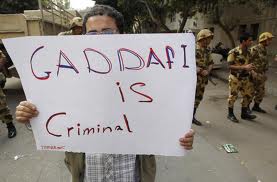
This month marks the end of an era. News of the capture and death of Colonel Mu'ammar Qadhafi in Sirte on 20th October was a truly momentous occasion for a country that had been held hostage to his brutal rule for more than 40 years. Stunned Libyans took the streets in jubilation as if they could hardly believe that the long awaited event had finally come true. As de facto interim Prime Minister Mahmoud Jibril declared, 'We have been waiting for this moment for a long time. Muammar Qadhafi has been killed.'

Qadhafi's death means that the country can finally start to put the trauma of the past 42 years behind it. Despite the fact that the country has been almost completely in the hands of its new leaders since the fall of Tripoli, as long as Qadhafi remained alive he was able to cast his dark shadow over the country.

As recently as the start of October, he was still calling on Libyans to rise up against their new leaders. While his calls for a million Libyans to come out and demonstrate were clearly completely far fetched, all the time he was alive he had the potential to create trouble.

His death therefore means that the country's leaders can now breathe a little easier as they work toward rebuilding their country. Furthermore, the liberation of Sirte that accompanied Qadhafi's death means that the National Transitional Council (NTC) can finally establish an interim government to oversee the political transition.

For more news and expert analysis about Libya, please see Libya Focus and Libya Politics & Security.
© 2011 Menas Associates

Thursday, 20 October 2011

NTC troops seize Sirte

According to a number of reports, Libya's National Transitional Council (NTC) has taken full control of Sirte. It is believed that the final efforts to seizethe city lasted for over an hour.

NTC troops have been involved in fierce battle with Colonel Mu'ammar Qadhafi's loyalist for weeks. Some are still resisting NTC troops in the town of Bani Walid, southeast of Tripoli.

Forces loyal to NTC have been facing heavy resistance from Qadhafi loyalists in the centre of Sirte, about 360km east of Tripoli. On Thursday (20th October) morning, the head of head of government operations in the eastern half of the city, Colonel Yunus al-Abdali told Reuters news agency: "Sirte has been liberated."

Al-Abdali added: "There are no Gaddafi forces any more…We are now chasing his fighters who are trying to run away." The NTC said it would declare liberation of Libya once the city of Sirte has fallen.

Qadhafi, who ruled Libya for four decades, was ousted in August. His whereabouts are unknown, however, several members are in hiding or have fled the country.

Sources: Reuters, BBC News, AP

For more news and expert analysis about Libya, please see Libya Focus and Libya Politics & Security.

Wednesday, 19 October 2011

Libya: NTC now claim to be in control of Bani Walid

As fighting continues in isolated pockets of the country, the National Transitional Council (NTC) now claim to be in control of Bani Walid which is one of the last remaining bastions of Colonel Mu'ammar Qadhafi loyalty. Following yet another push for the centre of the city, there were reports on 18th October that the new government had managed to raise its flag.

Sirte, however, appears to be offering some resistance, as probably only a few hundred heavily armed, but increasingly desperate, Qadhafi loyalists and mercenaries continue to withstand government forces. Although they have been forced into small pockets of the city, the fighting remains fierce.

Residents who had fled the fighting are now returning to areas that have been cleared of pro-Qadhafi forces. There have been several reports of looting in the city – albeit mainly against properties owned by Qadhafi's inner circle and business partners - which have been attributed to the NTC fighters' vengeance against Sirte's previously privileged position. Qadhafi favoured his home town, which grew from a small fishing village into an attractive and pampered town of around 50,000 with more modern infrastructure than nearby Misrata which has a population of over 350,000.

Last week, there were widespread reports that Mu'atassim Qadhafi had been captured in Sirte and had been flown to Benghazi. This led to wild celebrations in which 15 people were killed and around 70 were injured by falling bullets in Tripoli alone. There are now unconfirmed reports, mostly attributed to residents leaving Sirte, that Mu'atassim and Abu Baker Younis Jaber, head of the armed forces and one of the few remaining members of Qadhafi's original Revolutionary Command Council (RCC) – are still somewhere in the Sirte area.

It has been presumed that they are part of the small inner circle directing fighting in the former Leader's home town. Officially, there has been no confirmed sighting of anyone in Colonel Qadhafi's inner circle for some time. Al Jazeera reported that Saif al Islam Qadhafi escaped from Bani Walid about a week ago.

For more news and expert analysis about Libya, please see Libya Focus and Libya Politics & Security.

© 2011 Menas Associates