Both Yemen's President Ali Abdullah Saleh and the opposition have rejected the six-nation Gulf Co-operation Council's (GCC) initiative for a peaceful transition of power. Saleh has outright refused to step-down early, and the protesters rebuffed any suggestion of Saleh being granted immunity from prosecution.
The political turmoil in Yemen has been ongoing for almost two months. It is estimated that as many as 120 people have been killed in the clashes between security forces and anti-government protesters.
On Sunday 10th April, the GCC called on Saleh to resign as part of an agreement with the opposition. Saleh rejected the proposal, and the offer of mediation, saying he would not step-down before 2013.
The GCC had invited both the opposition leaders and the long term Yemeni president to Saudi Arabia for talks. It also offered Saleh and his family protection from prosecution for abuses of power, an offer which outraged the protesters who had specifically demanded that Saleh and his kin be put on trial.
According to several sources, Saleh despatched a letter to the GCC saying he could no accept the offer, but praised the organisation for its attempt to mediate the situation. His supporters, however, have rebuked the GCC calling its attempt to intervene a "flagrant interference in Yemen's internal issues."
For their part, the protesters took to the streets in their thousands in Sana'a, Taiz, Aden and other major cities.
Sources: Reuters, CNTV, Aljazeera.net, The Guardian
For more news and expert analysis about Yemen, please see Yemen Focus.
Showing posts with label Yemen protests. Show all posts
Tuesday, 12 April 2011
Friday, 1 April 2011
British nationals urged to flee Yemen amid protests
Anti-government demonstrators are set to face President Ali Abdullah Saleh's supporters in Yemen's capital Sana'a. Tens of thousands of people are taking to the streets as the country's political turmoil intensifies. Representatives of both sides have reportedly met and agreed to avoid confrontations, which have previously resulted fatalities.
According to a number of reports, anti-government protesters are moving towards the renamed "Change Square" near the Sana'a university, while supporters of the president are gathering in the city's Tahrir Square some 2km away.
Saleh, who has ruled Yemen for over 30 years, is under mounting pressure to step down immediately. Earlier in the month, in a bid to appease the brewing disconnect of the Yemeni people, he said he would step-down in 2012 but calls for his resignation have not subsided.
UK's Foreign Office has issued a statement urging British nationals to leave the ever-increasingly unstable Middle Eastern State immediately. The statement said: "Given the situation on the ground, it is highly unlikely that the British government will be able to evacuate British nationals or provide consular assistance in the event of a further breakdown of law and order and increased violent civil disorder. British nationals should therefore plan accordingly."
It also called on Saleh to take urgent steps to "build trust with the opposition and with the protesters…Without this trust, no agreement can be reached. The Yemeni people want to see their legitimate demands acknowledged and met and the UK fully supports them in this aspiration".
Sources: BBC News, Reuters, Politics, The Press Association
For more news and expert analysis about Yemen, please see Yemen Focus.
Tuesday, 15 February 2011
Yemen: Four days of protests result in violent clashes
Anti-government protestors have clashed with Yemen's security forces, on the fourth consecutive day of demonstration in the country's capital Sana'a; as thousands of demonstrators, calling for President Ali Abdullah Saleh to step down, came up against a crowd of Saleh supporters.
Police fired tear gas into the crowds to disperse them, while the protestors chanted: "After Mubarak, Ali". There were also reports of clashes between pro and anti government supporters south of the capital in Taez.
It is estimated that over 3,000 protestors clashed in Tahrir Square, some armed with broken bottles, daggers and stones. Police locked several thousand people inside the local university to minimise the violent confrontations.
Saleh is reportedly preparing to hold talks with opposition groups on possible political reforms, in an attempt to prevent his overthrow before time as he promised to stand down in 2013, and assured the nation that his son would not replace him in office.
Sources: BBC News, The Guardian, AFP
For more news and expert analysis about Yemen, please see Yemen Focus.
Monday, 14 February 2011
More anti-government protests in Yemen
Anti-government protestors and supporters of Yemen's President Ali Abdullah Saleh have clashed in violent attacks in Taiz, south of Sana'a. Reports have emerged that police fired arms into the air in order to disperse the crowds, but was unable to do so.
The demonstrations, inspired by those sweeping the Middle East, have been going on sporadically for a couple of weeks. During an uprising in the capital, protestors outside Sana'a University chanted, "Hey Ali, get out, get out…There is no solution except to leave."
Police intervened in the protest by building a wall between the two groups of demonstrators, consisting of 500 anti-government protesters and 100 supporters of Saleh. Anti-government protestors have been going strong in recent weeks, attracting as many as tens of thousands of people.
In order to appease the increasingly discontented public, Saleh offered significant concessions, including a pledge to step down in 2013. But, the protests seem far from over as the last couple of days confrontations between the two groups turned violent and saw rival members beating each other with batons and fists.
Police intervention has been reported to be unnecessary brutal, and liberal in its use of electroshock tasers. Voicing her concerns, Human Rights Watch Middle East and North Africa director Sarah Leah Whitson, confirmed that, “government security forces brutally beat and tasered peaceful demonstrators” without provocation.
Sources: Reuters, BBC News, New York Post, PA
For more news and expert analysis about Yemen, please see Yemen Focus.
Thursday, 27 January 2011
Yemeni people take to the streets calling on President Saleh to resign
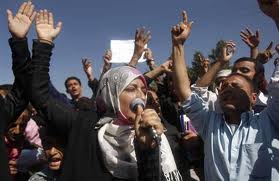
In the wake of the recent Tunisian uprising, and the riots that followed in Egypt and Algeria, thousands of Yemeni people took to the streets in the capital city of Sana'a calling on President Ali Abdullah Saleh to resign. Government opposition members and youth activists gathered across the city chanting anti-government slogans, and calling for economic reforms.
Much like in Tunisia, Yemeni people voiced their complaints about poverty, lack of political freedoms and increasing food prices. Yemen has been undergoing economic and security issues for years. The latter compounded by a separatist movement in the south and an uprising of Shi'a Houthi rebels in the north. Experts believe that Yemeni is fast becoming an Al-Qai'da battleground, with high numbers of Yemeni youths being recruited by the Islamist militant group.
The protesters also gathered at the Sana'a University chanting that it was "time for change", and referring to the uprising in Tunisia that ousted President Zine Al-Abidine Ben Ali earlier in January. Addressing the crowds, opposition MP Abdulmalik Al-Qasuss, from the Al-Islah party, said: "We gather today to demand the departure of President Saleh and his corrupt government."
Saleh, who has ruled Yemen since the north and the south merged in 1990, is expected to hand the power over to his eldest son, Ahmed, who heads the presidential guard. This and parliament's attempts to loosen the rules on presidential term-limits are two of the key issues that have angered Yemeni people, prompting them to take to the streets in protest.
Sources: BBC News, AngloPress, CNN, Ahram Online
For more news and expert analysis about Yemen, please see Yemen Focus.
Subscribe to:
Posts (Atom)


