Showing posts with label President Zine al-Abidine Ben Ali. Show all posts

Thursday, 27 January 2011

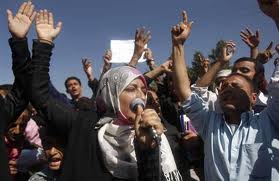
Yemeni people take to the streets calling on President Saleh to resign

In the wake of the recent Tunisian uprising, and the riots that followed in Egypt and Algeria, thousands of Yemeni people took to the streets in the capital city of Sana'a calling on President Ali Abdullah Saleh to resign. Government opposition members and youth activists gathered across the city chanting anti-government slogans, and calling for economic reforms.

Much like in Tunisia, Yemeni people voiced their complaints about poverty, lack of political freedoms and increasing food prices. Yemen has been undergoing economic and security issues for years. The latter compounded by a separatist movement in the south and an uprising of Shi'a Houthi rebels in the north. Experts believe that Yemeni is fast becoming an Al-Qai'da battleground, with high numbers of Yemeni youths being recruited by the Islamist militant group.

The protesters also gathered at the Sana'a University chanting that it was "time for change", and referring to the uprising in Tunisia that ousted President Zine Al-Abidine Ben Ali earlier in January. Addressing the crowds, opposition MP Abdulmalik Al-Qasuss, from the Al-Islah party, said: "We gather today to demand the departure of President Saleh and his corrupt government."

Saleh, who has ruled Yemen since the north and the south merged in 1990, is expected to hand the power over to his eldest son, Ahmed, who heads the presidential guard. This and parliament's attempts to loosen the rules on presidential term-limits are two of the key issues that have angered Yemeni people, prompting them to take to the streets in protest.

Sources: BBC News, AngloPress, CNN, Ahram Online

For more news and expert analysis about Yemen, please see Yemen Focus.

Thursday, 20 January 2011

Could Egypt follow in Tunisia's footsteps?

Could Egypt follow in Tunisia's footsteps? Could Jordan? Algeria? Libya? This is the question that has been asked repeatedly over the past few days since President Zine Al-Abidine Ben Ali took flight. There are parallels and likenesses between most Arab states: an ageing leadership increasingly out of touch with a young and frustrated population; lack of jobs; rising prices; absence of power sharing or real political debate; absence of the rule of law; corruption in high places.

There are, however, many differences, as much in degree as in substance. There is high level corruption in Egypt, but not to the extent of the mafia state that was Tunisia. A number of wealthy tycoons in Egypt, some in government, have made vast fortunes. But nothing compares to the stranglehold that Ben Ali and his wife's extended family had on most commercial activity. Nor does Egypt have the obsessive paranoia of Ben Ali in terms of information. The liberalisation of the media in Egypt does provide an important safety valve. Furthermore, while there are many poor, the provision of rationed goods means that no one starves.

For many in the Arab world, fear of fitna, of strife or chaos is too great for them to rebel against the state authority. This quietist attitude, helped by often repressive State security, has ensured the endurance of some very unpopular regimes.

What will Egypt do? One reaction would be to become more repressive of dissent. The alternative is to seek to defuse discontent by offering more political concessions. Or it could carry on as before, mindful of what has happened, making minor adjustments to deal with flare-ups.

For more news and expert analysis about Egypt, please see Egypt Politics & Security.

© 2010 Menas Associates