Showing posts with label President Abdelaziz Bouteflika. Show all posts

Tuesday, 2 April 2013

Mali should be under UN mandate, says Bouteflika adviser

One of President Abdelaziz Bouteflika's close advisers on terrorism and trans-national crime, Kamel Rezag-Bara , has issued a stark warning to the states involved in the military intervention in Mali, saying that the tensions in the region could destroy the state of Mali if political dialogue between rival camps is not reestablished as a matter of priority.
 
Speaking at a seminar, he also said that the number of parties involved in the conflict should be reduced urgently and the dossier be handed to the UN to avoid the exacerbation of the crisis. Arguing that Touareg demands had grown while the government in Bamako ignored them, Bara said political dialogue between the Malian government and the tribal groups in the north, Algeria's favoured policy all along, offered the only way out of the conflict. It is not often that the president's close advisers speak publicly on major policy issues.
 
For more news and expert analysis about Algeria, please see Algeria Focus and Algeria Politics & Security.
 
© 2013 Menas Associates

Monday, 19 November 2012

Algeria warns against intervention

 
President Abdelaziz Bouteflika's security advisor, Kalel Rezzag Bara, speaking on local national radio on 10 November, warned that military intervention in Mali was currently a useless step as it would only worsen the situation. He said that a peaceful settlement of the Malian crisis was still possible and that “It's necessary to reach an acceptable agreement to avoid the spill over of the Malian conflict into neighbouring nations."

Bara also said that the international community should distinguish between Tuareg rebels, the National Movement for the Liberation of Azawad (MNLA), who carry political claims and terror groups belonging to al-Qa'ida organisation and drug trafficking gangs. Interestingly, as part of Algeria's attempt to muddy the waters Bara included the Islamist groups Ansar al-Din alongside the MNLA when the former is in fact largely a creation of the DRS. Its leader, Iyad ag Ghaly has been a close associated of the DRS since the 1980s and is even spoken of in some quarters as “Algeria's man in Mali”.

Ansar al-Din, created in December 2011, is playing the lead role amongst the Islamists. The key question is whether Algeria still has effective control over it and whether the international community will believe its recent more conciliatory remarks. Kamel Bara is doing his bit in trying to get the international community to see Ansar al-Din as more allied to the Tuareg rebels than AQIM which has not been the case. Ansar al-Din's more conciliatory moves are part of Algeria's desperate moves to achieve a peaceful settlement and so prevent military intervention.

We should add that Ansar al-Din - along with AQIM and the DRS – heads the list in the International Criminal Court's (ICC) preliminary investigations into war crimes in northern Mali.

For more news and expert analysis about Algeria, please see Algeria Focus and Algeria Politics & Security.

© 2012 Menas Associates

Monday, 27 February 2012

Algeria: Government in panic over election

The government is in a panic over the up-coming 10 May election, and fears a massive abstention. The latest instructions being given to citizens by the government are along the lines of: “We know that many people are undecided on whom to vote for. That doesn't matter. Just go to the voting booths and get your fingers marked with the ink (dye). It lasts five days and we will be able to see who didn't vote. But, you don't have to vote. Just go to the polls to vote and get your fingers marked, but you don't then have to vote.”

In short, the government is not interested in how the votes are cast; it just wants people to register to vote to prove that there was a reasonable turnout – somewhere around 50-60%, or hopefully higher. The message also contains the veiled threat that those without 'ink on their fingers' will in some way be noted and perhaps punished.

The government's anxiety over an abstention, which would destroy its reform pretensions, were manifested by President Abdelaziz Bouteflika on 23 February when he addressed a ceremony in Oran to mark the double anniversary of the nationalisation of hydrocarbons and the creation of the General Union of Algerian Workers (UGTA). The president said that Algeria is witnessing a critical stage on both domestic and foreign levels. The country, he said, was “going through a sensitive period both internally and externally.” He went on to say that the world was also going through a difficult period. “It requires wisdom,” he said, “in dealing with the situation.” He warned Algerians against “rumours and false information.”

For more news and expert analysis about Algeria, please see Algeria Focus and Algeria Politics & Security.

© 2012 Menas Associates

Monday, 20 February 2012

Algeria: Death of General Mohamed Lamari

The former Head of the army and the General Staff, General Mohamed Lamari, died on Monday 12 February aged 72. According to his brother, who was quoted by the Ministry of Defence, Lamari died after being rushed to a hospital in his home town Biskra following a heart attack. He was buried in Algiers on Tuesday.

Lamari is regarded by many Algerians as the Algerian General with 'most blood on his hands'. He was one of the inner circle of Generals who overthrew the government in January 1992 to forestall the electoral victory of the Front Islamique du Salut (FIS). The latter FIS had won a substantial majority of the seats in the first round of voting in December and needed only a few more in the second round in January to take power.

President Mohamed Boudiaf, who was assassinated in June 1992 on the orders of the ruling Generals, including Lamari, issued an order in March 1992 that Lamari should be but the order was never carried out.

Lamari was a leader of the military's so-called 'eradicators' faction which opposed any reconciliation with the rebels. In 1993 he was appointed chief of the staff of the army. He created a specialist 'anti-terrorism' force of 15,000 whose task was to hunt down and kill Islamist rebels. An estimated 200,000 Algerians were killed during this 'dirty war' of whom at half were at the hands of the security forces.

Lamari began his military career as an officer of the French army having been trained at the Saumur cavalry school. He joined the ALN in Morocco a few months before Algerian Independence in 1962 and he then trained in Moscow at the Soviet Union's military academy.

Lamari 'retired' in 2004, officially for reasons of ill-health but it was generally known that he was dismissed by President Abdelaziz Bouteflika who replaced him with by the current Chief of Staff, General Salah Ahmed Gaïd.

Mystery has always surrounded Lamari's unexpected 'retirement' in 2004. The reason for his dismissal was a deal between Bouteflika and DRS Chief, General Mohamed Mediène. Behind the deal lay Mediène's desire to have Lamari removed from office so that he would become Algeria's undisputed 'strong man'. He therefore offered Bouteflika a deal whereby he arranged for the electoral rug to be pulled from under the feet of Ali Benflis, who was Bouteflika's main rival in the 2004 presidential election, resulting in Bouteflika capturing 85 per cent of the official vote and Benflis 6.4 per cent. In delivering this service, Mediène also persuaded Bouteflika that the best way to give Algeria and its presidency a new image after the 'dirty war' of the 1990s was for Bouteflika to get rid of the most hated general of that time. Hence Lamari's 'retirement'.

For more news and expert analysis about Algeria, please see Algeria Focus and Algeria Politics & Security.
© 2012 Menas Associates

Monday, 16 January 2012

Algeria: Ahmed Ouyahia will not stand down as Prime Minister

The congress of Prime Minister Ahmed Ouyahia's RND party was being held on Friday 6th th January as we went to press last week. It also came a few days after opposition party spokesmen had called on President Abdelaziz Bouteflika to appoint a new Prime Minister and Cabinet before the forthcoming parliamentary elections on the grounds that the present incumbents could not guarantee a fair election.

Ouyahia gave a typically belligerent response. He announced on Saturday 7 th that he would not resign in the face of opposition parties' demands for a technocratic government to guide the country through the May elections. “I will remain in my post and will not resign,” he told reporters. “The decision to disband the government belongs to the person who nominated it,” he added, referring to the president.

The most politically relevant moment of the Congress was Ouhayia's questioning of Bouteflika's presidency. Rumours, put out by the president's camp, that Bouteflika is considering a fourth presidential term after the next presidential elections, scheduled for 2014, have been circulating for the last few weeks. In his address to the RND Congress, Ouyahia questioned whether Bouteflika should seek a fourth term. Ouyahia asked the Congress whether another term for the ailing 75 year-old would serve Algeria's interests.

The statement was interpreted by RND members and reporters that Ouyahia was laying down his marker for the 2014 presidential election. Ouyahia, 61, told reporters, however, that it was too early for him to address whether he would run in the 2014 presidential election.

In 2008, the constitution was changed to scrap the two-term limit of presidential terms, thus allowing Bouteflika to run for a third term. Ouyahia defended his support for that change, saying that the country needed Bouteflika at a time when Algeria was recovering from its 1990s insurgency.

For more news and expert analysis about Algeria, please see Algeria Focus and Algeria Politics & Security.

© 2012 Menas Associates

Tuesday, 20 December 2011

Algeria: Serbia's Defence Minister signs agreement

Serbia's Defence Minister Dragan Sutanovac signed a military co-operation agreement with his Algerian counterpart, Abdelmalek Guenaizia, during his two-day 14-15th December visit to Algeria. Sutanovac told the media that: “Algeria is the Serbian Defence Ministry's most important partner in the military industry and both countries are interested in investing together in the development of new weapons and military equipment in the future.”

He was also reported to have met President Abdelaziz Bouteflika, but this remains unconfirmed, possibly because of his rumoured health relapse.

Sutanovac's discussions with Guenaizia centred on closer military ties and cooperation between the two countries. Their discussions reportedly covered:

a proposed expansion of cooperation between the two countries in military health care, in which Serbia claims considerable expertise

modernising the production of certain weapons and military equipment for the Algerian army

establishing Serbia weapons and military equipment plants in Algeria as part of its technology transfer programme

schooling Algerian officers at the Military Academy in Serbia

the visit to Serbia in the near future of a delegation of experts from of the Algeria's Ministry of Defence

a visit to Algeria by Serbia's President, Boris Tadic, in the first half of 2012.

For more news and expert analysis about Algeria, please see Algeria Focus and Algeria Politics & Security.

© 2011 Menas Associates

Monday, 10 October 2011

Algeria denies talks on Qadhafi's fate

On Friday 7th October, Foreign Ministry spokesman Amar Belani denied that the visit of the Qatari delegation to Algiers on Wednesday 28th September, led by Qatar's Prime Minister and Foreign Minister Sheikh Hamad bin Jassim bin Jabor Al-Thani – and the accompanying message from Qatar's Emir Sheikh Hamad bin Khalifa Al-Thani to President Abdelaziz Bouteflika – had anything to do with the fate of Colonel Mu'ammar Qadhafi. Immediately after the visit, there were reports, stemming from a foreign news agency, that Algeria had been holding secret talks with Qatar over the Libyan Leader's future.

Belani said: "I categorically deny the baseless news reported by a foreign news agency alleging the existence of secret talks between Algeria and Qatar over the fate of Colonel Mu'ammar Qadhafi." He went on to confirm emphatically that “Qadhafi is not on the Algerian territories".

Concerning reports of an imminent visit of a senior official from Libya's National Transitional Council (NTC) to Algiers, Belani said: "Well, at this moment, there's no such a visit on the agenda."

While it would be surprising for such discussions to have been held, especially in the light of the recent tensions between the two countries over Libya, Algerian government statements, especially 'denials' no longer have much credibility.

For more news and expert analysis about Algeria, please see Algeria Focus and Algeria Politics & Security.

© 2011 Menas Associates

Wednesday, 5 October 2011

Algeria: New media bill still restricts freedoms

The Arabic Network for Human Rights Information (ANHRI) says Algeria's new legislation does not liberate the media or give it the freedom of expression it deserves. On Monday 3rd October, ANHRI released a statement saying the new media bill endorsed by the Algerian Ministers Council goes some way towards abolishing the imprisonment penalty for journalists, but the wording of the bill itself, along with the severe fines which replace jail time, still restricts freedoms.

The bill was promised by President Abdelaziz Bouteflika as a measure of reform in order to quell protests against his rule. The protesters called for a number of other things, including the end to the state of emergency, which they've been demanding since the demonstrations began in February.

The media bill also covers the establishment of independent news satellite channels and/or radio stations, which are presently forbidden. Many have hoped that this would prove a step in the right direction. A film consultant at the Ministry of Culture Amed Bedjaoui welcomed the measure saying “for once, Algeria is no longer appearing on the international front pages with news about terrorism. The whole world is seeing this new openness in Algeria in a positive light”.

The new bill, however, stipulates several restrictions in regards to the formation of any independent news channel. Additionally, private newspapers are also expected to now be granted permission by the Authority Control for Publications.

Chairman of the Algerian Human Rights League (LADDH) Boudjemaâ Ghachir warned people not to be fooled. He said: “Once you get under the rather attractive wrapping, the present itself is poison.”

According to ANHRI, freedom of expression remains tightly controlled, despite the abolishment of imprisonment for any indiscretion or contention. The fines for any such offence range from €300 to €5000, an extortionate sum which the journalist must pay themselves, rather than it be paid by their employers. The salary of the average journalist working in Algeria is about €200, which according to ANHRI is set low so to deter them from writing about controversial issues for fear of having to pay a penalty.

The bill also restricts journalistic freedom in writing about every aspect of life such as state security, economic problems, public service, cultural and so forth. It also grants the authorities the right to “to punish a journalist or a newspaper when they cross the lines.”

ANHRI concluded: “Freedom is indivisible and cannot be granted from someone to another. It is a human right for all. Hence, the Algerian authorities should not provide half-solutions in an attempt to diffuse the revolutionary spirit experienced by the Arab region. Instead, they should provide genuine and complete reform ensuring public freedoms.”

Sources: BM, Reuters, AllAfrica

For more news and expert analysis about Algeria, please see Algeria Focus and Algeria Politics & Security.

Wednesday, 14 September 2011

Algeria to end State control of media

In what many consider a strategic move, Algeria has said it is in the process of making huge media reforms in order to allow private radio and television stations for the first time since the country gained independence in 1962. The move follows months of popular, if small, protests against high unemployment, governmental corruption and dearth of democratic freedoms.

The government has also reportedly agreed to drop prison time for journalists convicted of libel. Speaking about the proposed changes, President Abdelaziz Bouteflika said they would enhance democracy. He added that they would come into play once the parliament ratified the reforms. The cabinet said the reforms were part of a package announced by Bouteflika on 15th April.

During the address, Bouteflika said the government would publish a new information law and amend the constitution to "strengthen democracy". Additionally, the cabinet also said it would set up a new commission, which would include journalist, to regulate the media. It would also have the task of approving new press licenses and imposing fines for libel. Any media that was thought to threaten state security, however, would be banned or temporarily suspended.

Sources: BBC News, Reuters, WSJ

For more news and expert analysis about Algeria, please see Algeria Focus and Algeria Politics & Security.

Wednesday, 31 August 2011

Algeria: President Bouteflika meets his ministers

Since 2nd August, President Abdelaziz Bouteflika has held individual meetings with ministers, a regular summer tradition in which officials essentially show off the progress of their projects. As usual, an official summary of the meetings is distributed to the local press. In the context of this year's social upheaval, it has been particularly important that the president demonstrates progress on social development, security and wider reform, and, as a result, the exercise has turned into a public relations drive. Some of the negative aspects of ministries' work, particularly those touched by corruption scandals, have been bypassed.

Bouteflika congratulated public works minister Amar Ghoul on the “great achievements” in his sector. “The progress made in the road, airport and ports infrastructure has contributed to the process of national development,” said Bouteflika. There was no mention of the corruption scandals, costing errors and delays that have hit some major projects in the sector, notably the east-west motorway scandal, which is still making its way through the courts.

Despite the publicity around the ministerial meetings, no images of Bouteflika with his ministers were published, prompting suggestions that he was too frail to be pictured.

For more news and expert analysis about Algeria, please see Algeria Focus and Algeria Politics & Security.

© 2011 Menas Associates

Monday, 18 July 2011

Algeria: DRS purchase of Beur TV

Last week, we reported that the DRS, through one of its 'front men' had bought the French satellite TV channel, Beur TV. We can now give more details of the DRS' actions in this regard.

The background is that the Algerian national TV and radio broadcast network is wholly state-owned. The state, therefore, controls all of Algeria's broadcast media except the satellite channels. Access to these is relatively limited due to the relative lack of encoder and satellite reception facilities.

One of the key and much-publicised components of President Abdelaziz Bouteflika's promised reform process is that the broadcast media will be opened up. This is not because the regime necessarily wants to provide its citizens with access to more than its own very poor quality services. It is simply that the country's citizens are gradually finding ways and means of accessing external broadcast channels.

The state's soon-to-be-presented reform on opening up the broadcast media to foreign and private channels, however, is not so much a retreat in front of technologies that it cannot entirely control, as a strategy designed to 'get ahead of the game'. The DRS is planning to control the new broadcast media in three ways.

For more news and expert analysis about Algeria, please see Algeria Focus and Algeria Politics & Security.

© 2011 Menas Associates

Thursday, 23 June 2011

Algeria completes discussions on constitutional reforms

Algeria has completed two months of consultations about constitutional reforms. The country's government was propelled to act by the unrest sweeping across North Africa and the Middle East.

Two of Algeria's main opposition parties, the Front for Socialist Forces and the Rally for Culture and Democracy, shunned the process, calling it a sham and saying that President Abdelaziz Bouteflika will not adhere to his promises or enforce the reforms. Due to the domestic uprising in Algeria, and various other Arab nations across the globe, on 16th April, Bouteflika promised a new constitution and electoral laws.

Speaking about the trying two months, spokesman for the constitutional commission, Mohammed Ali Boughazi, said: "Our role was to listen to those who came without making comment or judging them…We respect the opinions of one and all, and we render them up to the president of the republic."

It is yet to be announced when Bouteflika will present the new constitution, but some sense of what the new document will contain is expected before the beginning of the holy month of Ramadan in August.

A politician who led the country from 1992 to 1995 Ali Kafi dismissed the new reform process, saying it was "trying to give an obsolete system one last breath".

Little of the recommendations have been made public, but certain broad outlines are well known, including limiting the president to two five-year terms, dividing power between a president and a prime minister, ensuring the independence of the judiciary, wresting TV and radio away from State control and accelerating economic growth.

Sources: AP, Forbes, eTaiwan News

For more news and expert analysis about Algeria, please see Algeria Focus and Algeria Politics & Security.

Monday, 9 May 2011

Algeria: Top-down reform

President Abdelaziz Bouteflika announced on Monday 2nd May that he would be appointing a committee, under the chairmanship of Abdelkader Bensalah, speaker of the Nation Council (Senate), to conduct consultations with political parties and national figures and to draft constitutional amendments.

In a speech to the Council of Ministers, Bouteflika said: "Concerning the draft revision of the constitution, I'm due to assign a competent committee to be in charge of this mission, while political parties and personalities can submit their propositions and contributions on the matter to this committee."

According to Bouteflika's modus operandi for the committee, it will present him with a draft constitutional revision, with the final version being submitted to parliament. “In case the draft carries [major] amendments, it will be referred to [a] popular referendum …, in addition to being submitted to parliament," he said.

This was the clearest assertion yet, that whatever amendments to the constitution were to be made, they would be 'top down' . The fact that Bouteflika himself is appointing the committee flies in the face of the widespread national demand that there be a popularly elected Council of State to decide such issues.

For more news and expert analysis about Algeria, please see Algeria Focus and Algeria Politics & Security.

© 2011 Menas Associates

Thursday, 24 March 2011

Protesters clash with riot police in Algiers

On Wednesday 23rd March, hundreds of people clashed with riot police in Algiers. The violence broke out in the early hours of the morning following an announcement by city authorities that a group of houses, built on public gardens, were there illegally and would therefore be torn-down. Reports of those injured vary: witnesses say that around 40 people were hurt, while the police says it is closer to 20, most of them being officers.

The latest clashes between Algerian people and security forces come amid rising tensions within the country over poor living conditions and unemployment. In light of the recent uprisings in the Middle East and North Africa, Algerian people are growing increasingly disenchanted with President Abdelaziz Bouteflika and his administration.

In a bid to placate the ever-increasingly disgruntled public, Bouteflika's government has promised progress in building more houses, roads and schools. On Saturday 19th March, Bouteflika's spokesman also announced political changes, but gave no details. It has now emerged that the promised changes would include a revision of the constitution to increase the prerogatives of the parliament, anchor the independence of the judicial branch from executive power, and cap the number of presidential terms.

A senior official with Algeria's National Liberation Front, Abdelhamid Si Afif, said the government intended to “modernize Algeria without plunging into uncharted political territory and violence” and will do so in accordance with the above outlined changes.

Sources: Wall Street Journal, Reuter, Euronews, BusinessLIVE

For more news and expert analysis about Algeria, please see Algeria Focus and Algeria Politics & Security.

Friday, 11 February 2011

Iran's new ambassador welcomed by Bouteflika

On Sunday 6th February, President Abdelaziz Bouteflika met Iran's new ambassador to Algiers, Mahmoud Mohammadi. In his welcoming speech, Bouteflika threw Algeria's weight behind Iran's right to use nuclear energy for peaceful purposes.

Bouteflika went on to say that Iran and Algeria share common positions on the main global issues, and expressed his country's resolve to strengthen bilateral ties and to consult with Iran in international organisations and bodies.

Bouteflika also noted that Iran has established amicable relations with Muslim countries, stressing that it had never attacked another country. Mohammadi, for his part, said that Iran was committed to strengthening ties with Algeria in all fields.

For more news and expert analysis about Algeria, please see Algeria Focus and Algeria Politics & Security.

© 2010 Menas Associates

Friday, 4 February 2011

Algeria: State of emergency to be lifted in the "very near future"

Algerian media has quoted President Abdelaziz Bouteflika as saying that the state of emergency will be lifted in the "very near future". It is yet to emerge, however, whether the emergency laws, imposed in 1992, will be repealed.

Bouteflika's announcement follows demands by opposition groups for greater freedoms. A co-organiser of the protests, Fodil Boumala, said: "We are in the middle of a meeting to work out how to respond. Personally, I hope very much that this is not just another ruse by the authorities ... I think that instead of getting to the root of the problem the authorities are just playing for time. They want to cut the ground out from the opposition by saying: 'You asked for the state of emergency to be lifted and now it is'."

After keeping out of the public eye, Bouteflika made the announcement at a meeting with government ministers in Algiers, adding that protests, currently banned in Algeria, will be permited to take place everywhere except in the country's capital. He also said state of emergency had been imposed "for the only purposes of the fight against terrorism, and it is this reason only which has justified maintaining it on a legal basis".

Bouteflika also reportedly urged the cabinet to adopt measures to promote emplouyment opportunities and encourage a more liberal media. The announcement follows growing pressure from the country's opposition groups, some of whom have been motivated by uprisings in Egypt and Tunisia.

Sources: BBC News, Reuters, Wall Street Journal , AP, AFP

For more news and expert analysis about Algeria, please see Algeria Focus and Algeria Politics & Security.

Monday, 24 January 2011

Algeria: Cevital in the firing line

Going on the offensive, the Algerian regime appears to have started a campaign against Cevital, the most dominant player in the Algerian private sector. The group controls 60–65 per cent of the cooking oil market and over 70 per cent of the sugar market, and is thus an easy target. In the wake of the riots, trade minister Mustapha Benbada began “demanding” that Cevital comply with the new pricing regulations introduced by the government on 8 January.

There was some confusion about the government's position, with El Watan reporting that “Benbada's strange order to Cevital” was inconsistent. “The same people who yesterday accused the group of raising prices, today accuse it of lowering them too much.” Cevital boss Issad Rebrab defended himself in Liberté, a newspaper which he owns, saying that he “strictly applied the agreement of 9 January”. The deal specified consumer prices of AD90 for a kilo of sugar and AD600 for a five litre container of olive oil, he argued, adding that Cevital has introduced lower prices to leave a margin for retailers.

The row may be in part a diversionary tactic on the part of the government, an attempt to deflect blame away from the state and towards the private sector, as well as an attempt by the regime to claw back market control for these two basic foods. There are those in the regime, particularly in President Abdelaziz Bouteflika's entourage who are keen to chip away at Rebrab's empire. As the newspaper Maghreb Emergent points out, Rebrab's relations with the president have been shaky for the past three to four years. The industry chief refused to support Bouteflika's bid for a second term in power in 2004.

For more news and expert analysis about Algeria, please see Algeria Focus and Algeria Politics & Security.


© 2010 Menas Associates

Friday, 21 January 2011

It is unclear what the Algerian regime will do

In view of the riots in Algeria, it is widely believed that the EU, some of its member states, and the US will ask the MENA states to 'make changes'. Indeed, it is widely believed that the visit of President Barack Obama's counter-terrorism advisor, John Brennan, to Algiers on 17th January was not really to discuss the US position on ransom payments to al-Qa'ida, as stated in the media, but to give a message to the Algerian regime “that it must do something”.

The US and EU are both frightened by the prospect of Islamists coming to power in any of the North African States. They, therefore, want sufficient change to prevent an outcome reminiscent of the FIS' victory of in 1991-1992.

It remains unclear what the Algerian regime might do. Having discussed the situation with both the opposition Rachad and our other sources in Algeria, we can proffer the following:

The regime has received a huge warning. It is weakened, frightened and unable to deliver the changes that are required. There are also signs that the Département du Renseignement et de la Sécurité (DRS) itself is uncertain, and probably divided on what actions to take.

The most likely immediate action is that both President Abdelaziz Bouteflika and Prime Minister Ahmed Ouyahia will be replaced; in Bouteflika's case on health grounds, and in Ouyahia's on purely 'political reshuffling'. The names of both Mouloud Hamrouche, whom we reported as being approached by the DRS two weeks ago and Ahmed Benbitour are in the frame, probably for President and Prime Minister, respectively. We do not know whether they will accept or whether others are also being considered.


For more news and expert analysis about Algeria, please see Algeria Focus and Algeria Politics & Security.


© 2010 Menas Associates

Thursday, 6 January 2011

Youth riots over mounting food prices


Algerian youths have staged a number of riots in protest to rising food prices. The clashes, which took place in the Bab El Oued area of Algiers, saw buildings set ablaze and roads in Tipaza barricaded with torched tyres. The rioting youths reportedly hurled stones at the police and "wrecked a bus shelter."

The outbreak of violence comes shortly after an increase in prices for milk, sugar and flour and mounting frustrations amid Algerians that the country's oil and gas wealth has done little to improve their living conditions. In trying to appease the nation, Algeria's Commerce Minister Mustapha Benbada said that the hike in prices was not unique to Algeria but a greater worldwide trend.

It is believed that several similar riots were also staged in other parts of the country - including Balkor, Bash Jarrah, Babal Wadi and Astawali - protesting against poor living condition and the mounting prices of basic comestibles.

There was a widespread feeling of anti government sentiments among the rioters who chanted slogans criticising President Abdelaziz Bouteflika and blaming his government for lack of water, power outages and poor distribution of social housing. Demonstrators posted videos on the internet of large fires burning in the streets and police trying to contain people with tear gas.

Algeria is still recovering from insurgency following the cancellation of the 1992 elections and while during his time in office Bouteflika has overseen a relatively calm period in the country, it is believed that the current uprising migh ignite further riots and violence.

Sources: Bloomberg, Ahram Online, Aljazeera, Washington Post

For more news and expert analysis about Algeria, please see Algeria Focus and Algeria Politics & Security.

Thursday, 9 December 2010

Algeria and Germany plans closer co-operation


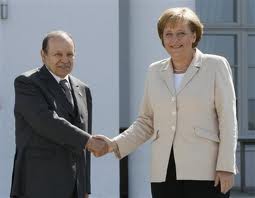
Algeria and Germany have unveiled plans for closer co-operation in the energy sector and socio-economic development. The plans were announced during President Abdelaziz Bouteflika's state visit to Berlin. Speaking about strengthening ties with Germany, Bouteflika said he hoped it would also involve a sharing of skills.

“We expect help with the training of our youth, which Germany is prepared to do. We are interested in a technology transfer, which Germany has also agreed to,” said Bouteflika.

“We are interested in helping with the exploitation of oil and gas reserves, but also to cooperate more closely with Algeria on solar and renewable energy,” said Chancellor Angela Merkel. She also pointed out the importance of the Desertec solar programme, which plans to harness solar energy in North Africa for distribution to Europe and the Middle East.

"I gave my assurance that we have a great interest in implementing Desertec, which is still a vision today," said Merkel.

Merkel commended Algeria for supporting its bid for a permanent representation on the UN Security Council, on which Germany is to begin a two year rotation. Markel also said that Germany planned to work with Algeria on security issues pertaining to the country's borders, curtailing illegal migration through North Africa to Europe.

Source: Deutsche Presse-Agentur

For more news and expert analysis about Algeria please see Algeria Focus and Algeria Politics & Security.