Showing posts with label Iraq. Show all posts

Tuesday, 19 August 2014

Oil production at Iraqi Kurdistan's largest-producing oilfield is set to rise to as much as 140,000 b/d by the end of the month

Oil production at Iraqi Kurdistan's largest-producing oilfield is set to rise to as much as 140,000 b/d by the end of the month
Oil production at Iraqi Kurdistan's largest-producing field is set to rise to as much as 140,000 b/d by the end of August despite the Islamic State’s advances into the region, the General Manager of Taq Taq Operating Company (TTOPCO), Onder Tekeli, said on 15 August.

Taq Taq Oil Field is jointly owned by the KRG (20%) and TTOPCO (80%) which is a joint venture between the Anglo-Turkish Genel Energy (55%) and Sinopec’s Addax Petroleum (45%) subsidiary. Tekeli stated "We have a target to ramp up production towards 140,000 b/d and I believe we would achieve this by the end of the month."

Radical Sunni militants of the Islamic State last week advanced to within a half hour's drive of Erbil, the capital of Iraq's Kurdish region and a hub for IOCs, before U.S. military air strikes thwarted their advance.

Several IOCs, including ExxonMobil and Chevron, operating in the previously stable Kurdish controlled region have evacuated all non-essential staff while other smaller producers, such as Afren and Taqa, have suspended operations, as reported here on 11 August.

In spite of KRG-based IOCs seeing their shares fluctuate, in a manner reflecting the Kurdish forces as they retreat and regain ground, there has been little impact on the overall oil output of the region. According to company estimates, production has only been cut by 5,000 b/d, although fighting between Kurdish Peshmerga forces and Islamic State fighters in the environs of Erbil have kept firms and investors on edge.

Currently unaffected by the Islamic State’s advances, however, Tekeli insists that morale at the Taq Taq oil field, 40km (25 miles) southeast of Erbil, remains high: "The worries started about the IS (Islamic State) fighters when they attacked the Makhmour camp. But we have not stopped working and our local staffers have expressed their commitment to us.”  Makhmour to the southwest of Erbil was the closes the fighting got to the capital last week.

Ozan Guler, production superintendent, stated that in order to increase Taq Taq oil field production beyond 140,000 bpd TTOPCO will set up three well-site production facilities to boost output: "We already have the potential to boost production up to 140,000 b/dd in our wells ... We will be setting up these new facilities whose start-up period is about 10 days."

Genel Energy, which operates the Taq Taq and Tawke oilfields in Kurdistan, has said it has evacuated non-core personnel from fields that are not producing oil. Last week it said that production was still ongoing at the two fields and it was averaging a combined 230,000 b/d.

Genel's shares fell by almost a quarter in early August as Islamic State forces advanced towards Erbil, but have since rebounded by around 12%.

At the end of trading, 15 August, they were up almost 2% at £824 (US$1,378.10). Although the rebound has slowed, Genel's shares are currently up 0.5% at £829.50 (US$1386.97).

(£1 = US$1.67).

For more news and expert analysis about Iraq, please see Iraq Focus.

© 2014 Menas Associates


Wednesday, 13 August 2014

Iraq: Talisman Energy Preparing Its Iraqi Kurdistan Assets For Sale

Talisman Energy, Canada's fifth largest independent oil and gas producer, said on 12 August that it still plans to sell all or a portion of its exploration properties in Iraq's Kurdistan region despite conflict in the area.

Brent Anderson, a spokesman for Calgary-based Talisman, said to Reuters that the company expects to begin the sale process in the coming few weeks and that an adviser has been selected to handle the marketing of the properties. He declined, however, to say who had been chosen to oversee the process. The company could sell all or part of its oilfields in the region depending on the amount of interest in the sale.

"We had anticipated going to the marketplace in the third quarter and this process has just started," Anderson said. "We have an adviser selected and we plan to go into the market with that adviser over the next couple of months."

The company is starting its sales process as 200,000 civilians, according to an UN Assistance Mission for Iraq (UNAMI) estimate, have been driven from their homes in the region in the last 48 hours and the United States carries out air strikes against the Sunni militants of the Islamic State, who have captured a third of the country.

Talisman has an interest in two oil blocks in Iraq's Kurdistan region: The Kurdamir block, which it shares with WesternZagros Resources Ltd, and its wholly controlled Topkhana property, where it has just completed the drilling of a promising well. It is now assessing the results of that drilling and has yet to release its findings.

Anderson said the company's properties have not been affected by the conflict in the region; nonetheless Talisman last week evacuated most of its non-essential personnel from the area.

Talisman, recently seen as a target of a potential takeover by Spain's Repsol SA, has long said it would like to sell all or part of its Kurdistan operations. However, the timing of the sale, coming during the fighting in the region, may deter some potential buyers.

Talisman shares, however, were up nine Canadian cents to C$11.56 by early afternoon on the Toronto Stock Exchange. C$11.56 is equal to US$10.59 and £6.32.

For more news and expert analysis about Iraq, please see Iraq Focus.

© 2014 Menas Associates

Monday, 11 August 2014

Iraq: IOCs in Kurdistan region see shares retreat as non-essential staff evacuated

The apparent stability and growing prosperity of Iraq’s more liberal and pro-business Kurdistan region has been undermined in recent weeks as Islamic State insurgents make significant advances into the Kurdish-controlled region. IOCs that were previously unaffected by the growing violence elsewhere in Iraq, are now seeing their share prices retreat in a manner reflecting those of the Kurdish forces.

Genel Energy, one of the IOC’s reaping the benefit of the export pipeline to Ceyhan in Turkey, has seen its shares shed 17% since the start of the month. London-listed Gulf Keystone Petroleum put out a statement on 7 August confirming that its production and trucking operations at its giant Shaikan field “remain safe and secure”, but this did little to prevent its shares falling by more than 11%. Norway’s DNO - , which has exploration, development and production interests in Kurdistan - was also hit, with its shares sliding 9.5%.

Following the lead of Chevron, ExxonMobil, Afren and Taqa, these companies, as well as Hess and its partner Petroceltic, have suspended operations in the  Kurdistan region and started to evacuate non-essential staff amid spreading violence in the region.

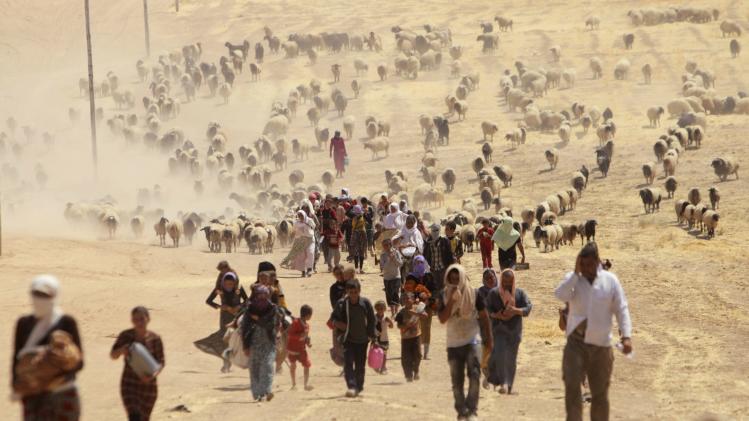
Last week Kurdish forces lost several  towns to Islamic State displacing 150,000 people largely from the Yazidi religious minority to according to a UN estimate. 

Considered to be ‘devil worshippers’ by the Islamic State, the Yazidis pray five times a day to the Malek Taus, the Peacock Angel also known as Shaytoun in the Kurdish language. Unfortunately, Shaytoun also means ‘devil’ in Arabic. The Islamic State has been accused of issuing an ultimatum to the Yazidi community to convert to Islam or face death, and reports from refugees state that these threats have been enacted through beheadings. 

The Kurdistan Regional Government has sent its Peshmerga forces to tackle the threat and the US has started air strikes, however, resulting in the recapture of two towns from Sunni militants on 10 August, one of the first victories for a military force that until now has been in retreat.

In a statement released 11 August, Petroceltic said “In conjunction with Hess Middle East New Ventures, our partner and the operator of our exploration activities in the Kurdistan Region of Iraq, we have been closely monitoring recent events in the region. While these developments have not directly impacted our exploration activities to date, in line with other operators in the region, it has been decided, as a precautionary measure, to temporarily secure and suspend operations (including the drilling of Shireen-1 exploration well in the Dinarta licence) and to evacuate non-essential personnel”.

Hess operates Iraqi Kurdistan's Dinarta and Shakrok fields, in which Petroceltic and the Kurdistan Regional Government have stakes of 16% and 20% respectively. The partners started drilling their first well, Shireen-1, on the Dinarta block in June and had expected exploration work to last five months. However, they decided to plug and abandon the Shakrok-1 well after disappointing exploration results.

Oryx Petroleum announced on 8 August that it had implemented a number of precautionary measures to protect its employees from the security developments in the region.  In the western portion of the Hawler license area the drilling operations at the Ain Al Safra and Banan sites have been temporarily suspended, both sites secured, and non-essential personnel relocated to Erbil given the proximity of such locations to recently reported hostilities in northern Iraq. 

In the central portion of the Hawler license area, drilling operations and facilities construction at the Demir Dagh field remain secure and operational but continue at reduced levels primarily due to the departure of certain third-party service company personnel from the site. Production from the Demir Dagh field has also been shut-in. 

The situation is moving fast in Iraq and with no sign of any easy solution to the advance of the Islamic State, which now controls parts of Syria and Iraq, including key oilfields that are funding the militants, investors should stay wary.

For more news and expert analysis about Iraq, please see Iraq Focus.

© 2014 Menas Associates
Monday, 4 August 2014

Iraq: Bitter-sweet developments for KRG as US Judge rules that US$100 million oil dispute should be settled in Iraq

Bitter-sweet developments for KRG as US Judge rules that  US$100 million oil dispute should be settled in Iraq
On 29 July we reported that a US judge, in response to a lawsuit filed by the Baghdad government, had signed an order to seize the US$100 million crude oil cargo from the United Kalavrvta tanker anchored off the Texan coast. It now appears that there have been some bitter-sweet developments for the KRG.

While US Magistrate Nancy Johnson issued an order to seize the tanker’s cargo, she also told lawyers for Iraq that the dispute should be resolved through the Iraqi court system. As the tanker is anchored 60 miles offshore, 50 miles outside of federal jurisdiction, the cargo cannot be seized.

Although the inability to seize the tanker’s US$100 million cargo is an obvious plus for the KRG it has come at a heavy price. Prior to the seizure order the KRG had managed to keep the end-buyers of its oil anonymous. However, the main US customer for the cargo has now been named as Lyondell Basell, who has subsequently stated that it would not take it, or any subsequent shipments, until the matter had been resolved by Erbil and Baghdad.  

The filing in federal court, Houston, stated that Iraq's central government has asked Iraq's Federal Supreme Court to block the Kurdistan Regional Government from exporting any crude until its ownership can be determined. The central government contends that the oil is not the sole property of the Kurdistan region of Iraq but belongs to the country as a whole. The KRG, however, asserts that its independent oil sales are their efforts to recoup the funds allocated to it, which the Iraqi central government has failed to supply them with.

The latest legal challenge follows Iraq’s bringing of criminal charges against the Kurdistan government in May, alleging theft of oil revenues. However, Kurdistan has failed to appear in court to address the charges and this "failure to comply with the summonses has effectively blocked the Federal Supreme Court from hearing the merits of the case." Harold Watson, a Houston lawyer representing Kurdistan, did not have an immediate comment on the filing when contacted by Reuters.

The U.S. government has expressed fears that independent oil sales from Kurdistan could contribute to the breakup of Iraq as the government in Baghdad struggles to contain the ultra-hardline Islamic State, a group of Sunni Islamist insurgents who have captured vast areas of the country.
Washington has pressured companies and governments not to buy crude from the KRG, but it has stopped short of banning U.S. firms from buying it outright.

For more news and expert analysis about Iraq, please see Iraq Focus.

© 2014 Menas Associates

Tuesday, 29 July 2014

Iraq: US court order halts US$100 million sale of Kurdish oil

US court order halts US$100 million sale of Kurdish oil
There have been new developments in the tit-for-tat struggle between Baghdad and Erbil over independent oil sales oil sales by the KRG. The Kurds have suffered a fresh blow to their attempts to sell the oil that they have been exporting via Turkey. It has been reported that an US judge, in response to a lawsuit filed by the Baghdad government, has signed an order to seize the US$100 million crude oil cargo from a tanker anchored off the Texan coast.

It was reported at the end of July that the United Kalavrvta, which left the Turkish port of Ceyhan in June, had sailed to the US and was planning to discharge at the Texan port of Galveston. The tanker informed the authorities that it was intending to discharge its cargo at sea into smaller vessels that would then deliver the crude to the port. On 27 July the US Coast Guard in Houston inspected the Marshall Islands-flagged tanker and cleared it for unloading which seemingly opened the way for the delivery to take place.

However, in its filing in the US District Court for the Southern District of Texas, Iraq asked for an order allowing the cargo to be seized by the US Marshals Service, arguing that independent Kurdish oil sales amounted to “smuggling”. Court filings showed on 29 July that the order had been granted by Judge Nancy Johnson. 

AET Offshore Services, an intermediary hired to unload the tanker, had previously asked in a separate court filing on 28 July if Iraq’s claims were valid. It is still not known who has purchased the crude oil and the court filings took no steps towards remedying this, by refusing to name the end-buyer. Companies have so far proved reticent about purchasing crude exported to Turkey from the Kurdish region because Baghdad has threatened legal action against all buyers of non-approved oil exports.

For more news and expert analysis about Iraq, please see Iraq Focus.

© 2014 Menas Associates

Friday, 11 July 2014

More than 150 Syrian students kidnapped by ISIS

More than 150 Syrian students kidnapped by ISIS

The Islamic State of Iraq and Sham (ISIS) has allegedly abducted between 153 and 186 boys aged 13-16 in the Aleppo region of northern Syria. Although largely unreported by conventional media outlets, bar brief reports in The Guardian and VICE News, it appears that ISIS has perhaps been influenced by Boko Haram’s April kidnapping of more than 300 schoolgirls from Chibok in north-east Nigeria.

Reports have recently surfaced that on 29 May 2014 a convoy of ten minibuses successfully completed the perilous 110 km journey from Ain al-`Arab (Kobani in Kurdish), on the Turkish border, to Aleppo to sit their end-of-year-exams as required by Syria’s educational system. The returning convoy was intercepted and redirected to an ISIS-controlled Islamic school in Minbej, just 66 km from Kobani, where the vast majority of the boys have remained. The primary source of what has been reported is Mustafa Hussan, one of five boys who managed to escape four days after the initial abduction. 

Hussan reports that, although the food was good, many boys were beaten by their international ISIS captors: ‘I saw a lot of Russians, Chechens, Libyans, some Saudi Arabians and Syrians too.’ Forced to undergo lessons in Islamic Shar’ia ideology and training in jihad, the boys were threatened with beheading if they attempted to escape. In spite of this, Hussan and four fellow students managed to escape via a roof under the pretence of raising a flag while their classmates distracted their religious teacher. Hassan stated that once they had escaped they were aided in their journey home by sympathetic locals.

Since their escape, unconfirmed rumours have surfaced that a further 15 students were traded for three ISIS combatants being held by Kurdish forces. What is certain, however, is that the longer the situation remains, the more difficult it will be to extract the students. Turkey’s Kurdistan Workers’ Party (PKK) has pledged its support to Kobani but the situation is complicated by the fact that ISIS has been carrying out deadly attacks on the city and surrounding villages since 2 July with weapons captured in Mosul. One attack, at Sheyoh, saw the execution of 24 Kurds, including two children.

Within the majority Kurdish city there is little faith that anyone outside of Kobani will help. According to a 2013 estimate by the Syrian Central Bureau of Statistics (CBS), over 85% of the total population of 44, 821 is Kurdish, with small Arab (5%), Turkomen ( 5%) and Armenian (1%) minorities.  The city itself is accustomed to both violence and its status as a minority stronghold. Founded in 1915 by Armenians fleeing genocide in Anatolia, who mostly emigrated to the Soviet Union in the 1960s, part of the city fell foul of the demarcation of the Syrian and Turkish border and has been assimilated into the Turkish city of Suruç. 

The vast majority of Kurds, following the principal of “my enemy’s enemy is my friend”, supported Syria’s minority Shi’a Alawite regime, believing that if the country were governed by the majority Sunni populace the Kurds would themselves be further ostracised and persecuted. In addition to what is taking place in the Kurdistan region of Iraq, which is proving a stumbling block to ISIS’ unrealistic attempts to form an Islamic Caliphate stretching from the Gulf to the Atlantic, the Syrian Kurdish allegiance to the regime has seen them become a target for sustained siege and, now, kidnapping and executions.

While the precise facts of what has happened remain unverified, what has crystallised is ISIS’ willingness to kidnap and enlist children in armed conflict, considered war crimes under International Humanitarian Law, to achieve its aims.

For more news and expert analysis about Iraq, please see Iraq Focus.

© 2014 Menas Associates

Thursday, 10 July 2014

IN DEPTH: Can Al-Maliki survive?

IN DEPTH: Can Al-Maliki survive?

Despite his characteristic resilience, can Prime Minister Nouri Al-Maliki survive the unfolding crisis in Iraq? In the first week of the crisis Al-Maliki appeared lost and unable to comprehend the political ramifications of ISIS's advances and seemed to have been written off by almost every side. It therefore seemed all but inevitable that the beleaguered premier would have to concede defeat and step down.

In typical style, however, he pulled himself together quickly enough and since then has been on the offensive. Al-Maliki is fighting back hard, something that will have won him further support and respect among some Iraqi Shi’as, many of whom believe that, rather than being the root of the problem, Al-Maliki is the man to protect them from what they see as a sectarian onslaught by the Sunnis and by terrorist forces. 

One should not forget that Al-Maliki still has the support of large swathes of the Shi’a population. His State of Law Alliance took the largest number of votes in the last elections and Al-Maliki himself won 720,000 votes, the largest share of any single candidate. For all that he may be despised and accused of being authoritarian and sectarian, Al-Maliki is still the strongman of the Iraqi political scene. 

All this makes it very difficult for the other political players to force him out. This includes his Shi’a rivals. That is not to say that they haven’t been trying. The Sadrists and to a slightly lesser degree the Islamic Supreme Council of Iraq (ISCI), are insisting on Al-Maliki’s departure, even going so far as to nominate alternative candidates for the premiership. At the end of June both blocs proposed Adel Abdulmehdi, the current deputy president, as their chosen candidate. 

Yet their efforts alone are unlikely to unseat Al-Maliki, who is not relying on either the Sadrists or ISCI for his third term. Aware that they were not going to give him a chance, he left both behind weeks ago, deciding instead to focus on forging alliances with other factions, including some Sunnis. It was through such alliances that Al-Maliki succeeded in getting the support of 165 MPs from a range of parties and currents outside the National Alliance. 

Thus for all that these big Shi’a players may be pushing for Al-Maliki’s departure they have little real influence over whether he stays or goes. 

Instead, Al-Maliki’s survival depends more on whether the State of Law Alliance and those smaller political forces that have thrown their weight behind him will continue to back him. There has been a lot of talk that key components inside the State of Law Alliance are ready to drop Al-Maliki. There have also been reports that the alliance is considering putting forward alternative candidates for the prime minister’s post. 

Among the names being circulated are Al-Maliki’s adviser Tariq Najm; deputy prime minister with responsibility for energy affairs Hussain Al-Shahrastani; deputy president Khodeir Khozei; transport minister and head of the Al-Badr Organisation, Hadi Al-Ameri; and national security adviser Faleh Al-Fayed. Notably, none of these individuals are from Al-Maliki’s Al-Dawa party, which had a weaker showing in the elections than many other components of the State of Law Alliance. 

Despite this talk, however, as yet there are no concrete signs that the alliance is about to crack or that it has any intention of withdrawing its support for Al-Maliki. This is perhaps unsurprising. State of Law is Al-Maliki’s creation and was built around him. Although there are other important figures within it, he is still the glue that holds it together and that enables it to attract so much public support. Thus abandoning Al-Maliki will not be that easy. That does not mean that they won’t do it. Much will depend on how much pressure the alliance comes under from other Shi’a parties, from other parts of the political establishment and from external forces, including Iran and the US – Washington clearly doesn’t want Al-Maliki to continue. 

As to whether those MPs from outside his alliance that Al-Maliki managed to win over will stick by him now this crisis has erupted, this is a more questionable matter. This is especially the case for those Sunni elements that Al-Maliki managed to pick off and bring over to his side, who may be persuaded to retract if they see that things are not going the prime minister’s way. Some of these elements might well falter if they see that the tide has turned against Al-Maliki and that the only way forward is to force him out of power. 

Al-Maliki’s days may well be numbered and without such support he will have no chance of holding on.

For more news and expert analysis about Iraq, please see Iraq Focus.

Monday, 24 February 2014

Baku interested in Iraqi natural gas


Azerbaijan has offered Iraq access to the Southern Gas Corridor, in a bid to help the war-torn country to export its gas to Western markets. Azerbaijani foreign minister Elmar Mammadyarov visited Baghdad on 10 February for talks with high-ranking Iraqi officials on deepening bilateral ties. 

“It is a huge project […] and it is open if Iraq has an interest in delivering its own natural gas,” Mammadyarov said during a joint press conference with his Iraqi counterpart Hoshyar Zebari. He added that other countries had already signalled to Baku their interest in contributing gas to the Southern Gas Corridor, although no details were revealed. 

Iraq produces limited quantities of natural gas, most of which is used for domestic consumption. Considerable volumes of associated gas is still flared due to the lack of facilities to use it more productively. But the government is increasingly focused on stepping production for export. 

During his meeting with Iraqi prime minister Nouri al-Maliki, Mammadyarov said that Azerbaijan was planning to open a full-fledged embassy in Baghdad in the near future. A permanent diplomatic mission in the Iraqi capital has already been authorised by the Azerbaijani parliament. “Our companies want to work and invest in Iraq, especially in its energy sector,” he added. 

Azerbaijan is not the only country interested in Iraq’s natural gas resources. Earlier this month, an Istanbul-based newspaper  quoted Turkish energy minister Taner Yildiz as saying that Ankara might prefer gas imports from Iraq to its current gas supplies from Russia, Azerbaijan and Iran. He said the price of Iraqi gas might prove much lower, because it would not have to cross foreign territory and would travel a shorter distance. 

Last June, Ashti Hawrami, minister of natural resources in Iraq’s Kurdistan Regional Government, told the press that his government envisaged the start of natural gas supplies to Turkey as early as 2016. At the initial stage, around 10 billion cubic metres of gas is planned to be supplied across the border. Iraqi Kurdistan is set to begin oil deliveries to Turkey this September.

For more news and expert analysis about the Caspian region, please see Caspian Focus.

© 2014 Menas Associates

Friday, 23 August 2013

Iran to export gas to Iraq


Iran and Iraq have signed a high-profile agreement according to which Iran will supply 25 mcm/day of natural gas to the Al-Baghdad, Al-Mansouriyah, and Sadr power plants in Iraq.
 
The deal was signed by Petroleum Minister Rostam Qasemi and his Iraqi counterpart, Abdul Kareem Luaibi, in Baghdad. Iran will earn $3.7 billion a year from the deal.
 
In related news, the United States has announced that it is concerned about a $14.8 billion gas deal between Iran and Iraq and has asked Baghdad to explain it. The US State Department said that it plans to inform Baghdad about the implications with respect to sanctions.
 
In response, Mussab al-Mudaris, a spokesperson for the Iraqi Ministry of Electricity, emphasised that the natural gas supplies from Iran would help to ease electricity shortages by feeding two power plants in a Baghdad suburb.
 
For more news and expert analysis about Iran, please see Iran Strategic Focus.
 
© 2013 Menas Associates
 

Thursday, 25 July 2013

Iraq-India strengthen energy ties

 
Iraq has moved to strengthen its relations with India by offering the country three contracts to develop blocks in the Middle Furat oilfields. The three blocks are Kifil, West Kifl and Merjan.
 
The offers were made during the recent visit by Indian oil minister Veerappa Moily to Baghdad. Moily came as head of a 28-member delegation that was in Iraq to participate in the 17th India- Iraq joint commission on economic and technical co-operation, held on 7 July. This commission is aimed at broadening bilateral co-operation across a number of sectors including energy, agriculture, affordable housing, higher education and tourism.
 
What was unusual about the offers was that they were awarded without any bidding process. This is a rare occurrence in Iraq, outside of the KRG, suggesting that Baghdad is particularly keen to develop its relations with Delhi.
 
It was reported, too, that Iraq has also agreed to renegotiate the contract that was awarded to Indian company ONGC Videsh (OVL) in 2000 for block 8. The Saddam Hussain regime initially offered OVL a production-sharing contract for the block, but later changed its mind and sought a contract renegotiation. The post-Saddam Hussain government initially agreed to honour the PSC with OVL, but reportedly then had second thoughts, preferring the service contract model instead. Negotiations over the contract have been at a standstill. However, following Moily's visit, Iraq is now willing to start renegotiations with the firm for the block.
 
In addition, according to a statement issued by the Indian Oil Ministry, Iraq has agreed to consider investing in Indian Oil Corporation's Paradip refinery. According to the refinery project executive director, M Vijaywargiya, the refinery, at Jagatsinghpur in Odisha, is set to be commissioned in September–October this year. The Oil Ministry also stated that Baghdad is open to considering extending 60 days credit for crude sales to India.
 
For more news and expert analysis about Iraq, please see Iraq Focus.
 
© 2013 Menas Associates

Wednesday, 27 June 2012

Iraq: Ninevah seeks own deal


Tensions between Erbil and Baghdad over the energy issue were stoked further this month when Ninevah waded into the heart of the battle. The head of the Ninevah governorate council, Atheel Al-Najayfi , a member of Iraqiya and brother of the head of parliament, Osama Najayfi , put the cat among the pigeons when he declared that he was in support of ExxonMobil 's Kurdish deal. It was also alleged that Al-Najayfi had struck his own deal with the Kurds, in which he had agreed to hand over 10km 2 of land from the governorate, comprising the oil-rich areas of Sheikhan and Quosh, so that the area could be included in the ExxonMobil deal.

It later emerged that such allegations were somewhat overplayed. Al-Najayfi admitted that his discussions with the KRG were still in their early stages and had not got as far as striking any deal. He told the local media, “We never discussed the reality of these contracts with the KRG… We were just in the initial stages. The second stage would be to go through legal bodies.”

However, it also emerged that Al-Najayfi had got as far as establishing and heading a factfinding mission and that he had contacted the US embassy in Baghdad to ask for its help in contacting ExxonMobil. When the embassy declined to contact the oil major on the mission's behalf, it asserted that it would find other ways to get in touch with the oil giant.

Atheel's request was a totally unexpected move from the Sunni camp. Given the tensions between the Sunnis and the Kurds in the area, it seems almost inconceivable that Atheel would have made such an overture to the KRG. However, his doing so was his way of sending a clear message to Baghdad: the government has failed to invest enough in Ninevah and thus the governorate wants greater control over its own resources. Atheel complained that the governorate has been marginalised and that it has had no say in the contracts signed for blocks in the region so far.

Furthermore, the move should be considered within the context of the political crisis that has enveloped the country. This was Atheel Al- Najayfi's way of taking a pot shot at Prime Minister Nouri Al-Maliki . As he told the Al-Sharq Al-Awsat newspaper after the news broke, “Until now we are not party to the contract but I am saying that we have to negotiate with our brothers in the KRG and the American company to guarantee our governorate rights and the governorate council needs to give its authorisation to enter into discussions.” He also declared, “Ninevah must be engaged in oil investments and not away from them, whether through contracts that the KRG has signed or that the central government has signed. We need oil and electricity.”

For more news and expert analysis about Iraq, please see Iraq Focus.

© 2012 Menas Associates

Tuesday, 13 September 2011

Top Iraqi corruption investigator resigns

Iraq's Prime Minister Nouri Al-Maliki has accepted the resignation of Judge Rahim Hassan Al-Uqailee, the man leading Iraq's fight against corruption, in a blow to efforts to clean up the country's government and parliament.

Al-Uqaliee, the head of the country's Integrity Commission, submitted his resignation on 8th September, citing “pressure from political parties” to cover up corruption and a lack of political support for his agency.

Despite al-Uqaliee's public frustrations with stonewalling politicians, other explanations for his resignation are already circulating in Iraq's febrile political atmosphere. One of the members of the parliamentary committee on integrity, Sabah Saadi, claimed that the ruling party was pushing al-Uqaliee to launch “false and fabricated” corruption probes against political figures including Ahmad Chalabi, the US's former protégé in Iraq.

One of Saadi's fellow committee members, however, said that al-Uqaliee's resignation was a result of his failure to produce results in tackling Iraq's rampant corruption, ranked as the fourth worst in the world by Transparency International.

A third MP, Shakir Kitab claimed that the resignation “sheds light on complicated political relations and lack of transparency and stability in the government” rather than on the activities of one or another political bloc.

On 12th September, al-Uqaliee reiterated his reasons for resigning in a public letter to the integrity committee. In it, he declared that “the fight over stealing the money of the state and its property is the unspoken part of the struggle for power in Iraq today”. Despite such obstacles, however, in 2010 the Integrity Commission issued 4,082 arrest warrants for government officials, including 197 high-level figures.

According to Iraqi MPs, al-Maliki is planning to replace al-Uqaliee with a fellow member of his Dawa Party, Ala' al-Sa'idi. It remains to be seen whether the new head of the Integrity Commission will be able to ignore the pressures and obfuscations of shady officials.

Sources: AFP, Los Angeles Times, Aswat Al Iraq

For more news and expert analysis about Iraq, please see Iraq Focus.

Tuesday, 1 February 2011

Iraq: Budget still not ratified

Iraqis are increasingly concerned that the 2011 budget still hasn't been ratified. Part of the reasons for the delay, aside from the objections made by the Kurds is because many MPs are objecting to the figures. There is a strong feeling that the budget is simply being sucked up by the state and that there is insufficient money being channelled into investment or development. Some 80 per cent of the budget is to go on operational costs.

Many people baulk at what they view as the excess costs and expenses of key public officials. They are particularly angered by the sums eaten up by what are known as the 'three presidencies' – the president, the prime minister and the head of parliament – which alone cost $2.421 billion a year. This is more than is allocated for some of the most important ministries, such as agriculture and industry. The expenses of the presidencies are not transparent and many feel that huge sums are being wasted on “secret expenses”. The local governorate councils are also protesting at the percentage of the budget allocated for them.

Therefore, despite attempts to rush this budget through parliament to release funds to pay essential costs for 2011, it looks as though many amendments are going to be demanded and will need to be dealt with by the cabinet before it can finally be passed.

For more news and expert analysis about Iraq, please see Iraq Focus.


© 2010 Menas Associates

Wednesday, 8 December 2010

Zubair field hits peak output target


Eni has said that production in Iraq's Zubair field has reached its peak output target of 1.2 million b/d. The field, which is already profitable, is divvied up between Missan Oil Company (25%), Eni (32.81%) Occidental Petroleum (23.44%) and Kogas (18.75%).

According to Eni output at Zubair has reached 201,000 b/d, showing a 9.8 per cent rise from when the service contract commenced on 18th February 2010. Zubair, one of the biggest oil fields in Iraq, is located near Basra in the south of the country.

"The consortium's contract cost recovery commences, with the group earning a remuneration fee of $2 per barrel on incremental production," said Eni in a statement.

For more news and expert analysis about Iraq, please see Iraq Focus.

© 2010 Menas Associates

Thursday, 23 September 2010

Antiquities uncovered in boxes in a storage room in Nouri Al-Maliki's office


Iraq's National Museum finally took possession this month of over 600 antiquities, some dating back to the third millennium BCE, which had been returned to Baghdad by the US in early 2009 but which had subsequently gone missing. The artefacts, which included jewellery, bronze figurines and clay tablets from various eras and which were seized by US customs officials, turned up in boxes in a storage room for kitchen equipment in office.

According to antiquities minister Qahtan Al- Jubouri, the disappearance of the returned antiquities, which had been smuggled out of Iraq since the toppling of the former regime, was the result of “inappropriate handover procedures”.

It seems that when the US army handed them over to Al-Maliki's office there was no representative for antiquities or heritage present and the objects were put away in the unlabelled boxes they were returned in and simply forgotten about. An inquiry triggered by Al-Maliki's office led to the objects being unearthed.

Whilst the find is great news for Iraq's heritage around half of the 32,000 pieces stolen from archaeological sites and from the National Museum are still unaccounted for.

For more news and expert analysis about Iraq, please see Iraq Focus.

© 2010 Menas Associates