Showing posts with label President Ilham Aliyev. Show all posts

Friday, 11 March 2011

Azerbaijan clamps down on planned opposition protests

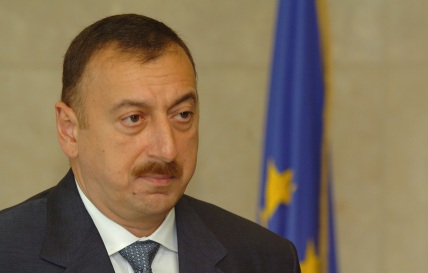
The tide of protests sweeping the Arab world have inspired opposition campaigners in Azerbaijan to try the same. Small gatherings and online campaigns in solidarity with Arab protesters have been occurring sporadically since early February. Now, using social-networking tools, primarily Facebook, youth activists have called for a day of action (or a 'Great People's Day') on 11th March to protest against the rule of President Ilham Aliyev.

Protestors are being cautious. Of the several 11th March groups, some are insisting that their actions will only be virtual. The main Facebook group declared on 8th March, somewhat prematurely that “The PEOPLE's Revolution is Victorious!”, indicating that there was little intention to seek such a victory on the streets. One of the organisers of the group stated that it was up to individuals how to show their commitment.

The organisers' prudence is understandable given recent crackdowns on youth and opposition activists. One of the organisers of the 'Great People's Day' was detained on 4th March: he will be held in pretrial detention for a month on charges of dodging military service. Other activists have been visited by police, harassed, or detained. Pro-government youth groups have organised counter-campaigns, and police have also made it explicit that any unauthorised rallies will be “resolutely thwarted.”

Nonetheless Musavat (Equality), the main opposition party, has also called for street demonstrations the following day, 12th March, although the party's support is fairly low. More concerning for the government is the danger of youth groups fusing with demonstrations on social issues elsewhere in the country. In late February protests were reported in Sabirabad, west of Baku, where residents demonstrated against the government's handling of floods last summer and its continued failure to provide compensation; and in Nardaran, a village north of Baku known for its Islamic piety, against power shortages and unemployment.

Aside from dispersing demonstrators and targeting online activists, the government's response has been a well-publicised anticorruption campaign. A long-dormant anti-corruption commission returned to work and dozens of low and mid-ranking government officials have been publicly fired for graft. Whether this will lead to sustainable progress in tackling corruption is, without radical changes at the top of the country's power elite, unlikely.

Nonetheless the government's fear of an Egypt-style uprising looks overblown. The online campaign is low-key and uncoordinated, whilst targeted harassment of opposition activists has disrupted attempts to organise the movement. Isolated protests in other towns are nothing new and can usually be tackled by a combination of heavy policing and promises of more cash and services. The cases of Tunisia, Egypt and Libya prove that nothing is impossible, but all indications suggest that Azerbaijan will be spared widespread unrest at present.

Sources: Radio Free Europe/Radio Liberty, Eurasianet, Bloomberg

For more news and expert analysis about the Caspian region, please see Caspian Focus.

Wednesday, 16 February 2011

Terror threat increases as Baku-Iran tensions mount

In late January, the US Embassy in Baku issued a warning to its citizens in Azerbaijan of a terrorist threat against American interests. On 11th February, the Embassy reiterated its warning, stating that “[t]he threat remains serious”. No further information was provided.

In a parallel development, on 15th February Israel's Foreign Ministry said that several of its embassies had received information on specific threats in Azerbaijan as well as Armenia, Georgia, Turkey and others. The exact reason has not been publicly disclosed, but numerous reports attribute the increased state of alert to the upcoming third anniversary of the death of Imad Mugniyeh.

Mugniyah was a senior military commander in Hezbollah, the Lebanese Shi'a militant group, until he was assassinated by a car bomb in Damascus in February 2008. Since then, reprisal attacks have been plotted and thwarted on several occasions, including in Baku in mid-2008 when alleged Hezbollah agents tried to blow up the Israeli Embassy. Iranian backing was suspected, as it was in several other recent terror plots in Azerbaijan (although nothing was ever proven).

As well as the anniversary of Mugniyeh's death, the recent increase in the Baku threat levels also coincides with other interesting developments. On 10th January, police arrested the head of the Azerbaijan Islamic Party (AIP), a small unregistered outfit, for calling for the overthrow of President Ilham Aliyev's government. The call from Movsum Samadov came following a ban on wearing the hijab in public buildings, a ruling which Samadov denounced.

Iranian officials have criticised the arrests, sparking a tumult of anti-Iranian sentiment in Baku. It is perhaps unsurprising, given the repeated accusations that Iran is interfering in Azerbaijan's affairs, allying with Azerbaijan's arch-rival Armenia, and attempting to export its own brand of revolutionary Shi'a Islam (through groups such as the AIP).The government, however, appears to be encouraging public anger: it made no move to stop the protests, and reportedly instructed television stations to broadcast an anti-Iranian documentary.

Drawing a link between the Tehran-Baku animosity, and the increased threat levels to the US and Israeli embassies, could be a leap of the imagination. The resurgence of Islam in Azerbaijan, however, supported in many cases by Iran, is undoubtedly causing concern in Baku. The AIP arrests and the terror alerts may not be directly linked, but they are all part of a much larger and much murkier picture.

Sources: Eurasianet, APA, RFE/RL

For more news and expert analysis about the Caspian region, please see Caspian Focus.

Wednesday, 8 September 2010

Azerbaijan and Russia sign another gas deal


Gazprom has secured an agreement to supply State Oil Company of Azerbaijan Republic (SOCAR) with double the amount of Russian gas in 2011, expected to total at 2billion m³. Under the agreement, Azerbaijan is expected to increase gas imports from Russian even further by 2012.

The agreement signed by Russia's President Dmitry Medvedev and Azerbaijan's President Ilham Aliyev is the third gas purchase agreement signed in the past year between the two countries. The first agreement, signed in October last year, provided for Russian purchases of 500million m³ of gas annually.

During a joint news conference on Friday 3rd September , President Aliyev said the gas deal with Russia was “open and sincere.” He also took the opportunity to reassure Azerbaijan's Western partners that energy co-operation with Russia would not come at their expense, saying "We don't see our work in the gas sector as an opportunity for unfounded competition. We are working not on the basis of political concerns, but economic practice".

Talking about the latest deal with Azerbaijan, President Medvedev said that both countries are serious, “gas suppliers,” and will not create obstacles for one another when it come to co-operation with international energy majors.

Source: EurasiaNet

For more news and expert analysis about the Caspian region, please see Caspian Focus.

Thursday, 22 July 2010

Eni in talks with President Aliyev about CNG project


Eni's CEO, Paolo Scaroni, has met with Azerbaijan's President Ilham Aliyev, and several other government officials, to discuss Eni's come back to Azerbaijan's upstream sector, and the compressed natural gas (CNG) project. Eni plans to appeal for a permit that would enable the company to transport several billion cubic meters of Turkmen gas across the Caspian Sea to the coast of Azerbaijan, from where it would then be transported through an overland pipeline to other destination ports.

Scaroni has recently met with Russian, US and EU government officials to deliberate the financial and commercial aspects of the project which is the first of its kind to be studied in the Caspian region, and would permit a substantial reduction of gas flaring in Turkmenistan.

The technology involved allows transportation of high pressure gas (not liquefied) by specialist containment systems within the vessels, and allows feasibility of projects otherwise not achievable with traditional technologies such as transport by pipeline or liquefied natural gas (LNG).

To find out more about Eni please visit Eni's web site, which you can find here.

For more news and expert analysis about the Caspian region, please see Caspian Focus.

© 2010 Menas Associates