Showing posts with label International Criminal Court. Show all posts

Wednesday, 23 March 2011

South Sudan seeks peacekeeping force for border

The UN Security Council met on Monday 21st March to discuss the situation in Sudan, and Pagan Amum, secretary-general of the South's Sudan People's Liberation Movement (SPLM) said he asked the council to consider deploying a new peacekeeping force at the border.

According to AllAfrica, the meeting was an unofficial sitting of the council, held in response to a request from a people's organisation in the US on the disputed Abyei region, although this has not been confirmed.

In a statement to Sudan's SUNA newspaper, Khalid Musa , the spokesman of the Ministry of Foreign Affairs, said the request for an unofficial meeting reflects an 'unjustifiable trend towards escalation', resulting from the failure of some circles in South Sudan to solve their own political issues.

Musa said the Sudan's envoy to the UN had made available all the facts for the Security Council and reiterated his government's commitment to the peaceful solution of all issues.

Speaking after the meeting, Amum said that the UN would be involved in investigating the Northern National Congress Party 's aid to the renegade general, George Athor , that the SPLM/A is currently fighting. The south has in recent weeks accused the north of working to destabilise the South, and has recently withdrawn from talks.

The two sides have also bickered over UN Mission in Sudan head Haile Menkerios 's flying to Abyei on a UN helicopter with Ahmed Haroun , an NCP member who is wanted by the International Criminal Court for war crimes in Darfur.

Amum said that Menkerios was wrong for flying with Haroun, but according to Inner City Press , UN Peacekeeping Assistant Secretary-General Atul Khare criticised the SPLM for not granting it access.

South Sudan is preparing to declare its independence from Sudan in July, following an independence referendum in January, but the transition preparations have been overshadowed by violence in recent weeks. There has been considerable violence in the disputed border area of Abyei, as well as within South Sudan between supporters of rebel general Athor and the SPLA.

Amum said he asked the council to think about deploying a new peacekeeping force to the border, but it is not yet clear how that request was received.

Sources: Canadian Press, Inner City Press, AllAfrica

For more news and expert analysis about the Sahara region, please see Sahara Focus.

Thursday, 10 February 2011

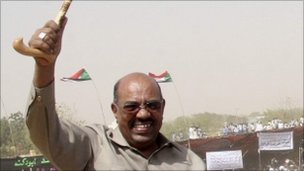
President Al Bashir wants a “reward” for accepting Southern Sudan's independence

Reports have emerged that Sudan wants the arrest warrant for President Omar Al Bashir withdrawn as a “reward” for him accepting Southern Sudan's independence. Al Bashir vowed to recognise Southern Sudan as an independent State after 99 per cent of voters backed secession.

The January vote was a clause in the 2005 peace treaty, which ended several decades of civil war between North and South Sudan. Initially, al Bashir was opposed to the split and sought to delay the referendum but eventually acquiesced amid conflicts, street protests and rebels uprising in western Darfur, and along the eastern border with Ethiopia.

The International Criminal Court has indicted the Sudanese leader for allegedly ordering genocide in the western region of Darfur, but there's speculation that the West may defer the arrest warrant as a “reward” if al Bashir co-operates with the South's breakaway process. Additionally, the US hinted that it may take Sudan off their list of states which sponsor terrorism, if al Bashir does not interfere with the transition process.

It is yet to be seen whether or not the West will void the warrant, however, Souther Sudan's independence will clearly diminish al Bashir's power over roughly a third of Africa's largest nation. Our sources in Sudan, say that despite several pending border disputes, the North and the South will have to find middle ground if it is to bring in oil revenues as much of the country's oil is in the South and refining technology in the North.

Sources: BBC News, AFP, AOL

For more news and expert analysis about the Sahara region, please see Sahara Focus.

Tuesday, 27 July 2010

Britain to strengthen trade ties with Sudan


Britain's minister for Africa, Henry Bellingham, said that Britain is keen to strengthen its trade links with Sudan despite the US sanctions, and the pending arrest warrant for President Omar al-Bashir over the Darfur conflict.

"One of our top priorities is to increase trade with different countries around the world, particularly in Africa. The trade we have with Sudan at the moment is very good. Our bilateral trade is well over £100 million but we feel the scope for that trade can increase,” said Bellingham during a conference in Khartoum.

Bellingham told reporters that the oil trade was "very important", but also said that British oil producers were, "lagging behind in the exploration and exploitation of oil all over Sudan," where there is great potential.

It is estimated that Sudan produces approximately 500,000 b/d, and has reserves of 6 billion barrels between its north and south divide. More recently commercial trade with Sudan has been made difficult due to the US sanctions against Khartoum imposed, in 1997, on grounds of cultivating international terrorism.

"There are no UK sanctions, there are US sanctions," said Bellingham and maintained that Britain still wants to see “more UK banks taking a positive view toward Sudan.” In addition to the sanctions, the International Criminal Court (ICC) added three genocide counts to existing charges against Bashir for alleged war crimes and crimes against humanity in Darfur.

Talking about the outstanding arrest warrants, Bellingham said that the British government supports the ICC’s decision and encourages the government of Sudan to “collaborate with the court over the existing arrest warrants,” before adding that Britain does not have an “argument with the Sudanese people," and therefore feels it would be "wrong" for Britain "not to encourage the trade because trade equals wealth creation, jobs, prosperity, sustainability."

Source: Middle East Online

For more news and expert analysis about Sahara, please Sahara Focus.